

Author: Devanssh Mehta
B.Pharm., M.Pharm. (Pharmacology), MBA
Meerut, Uttar Pradesh, India
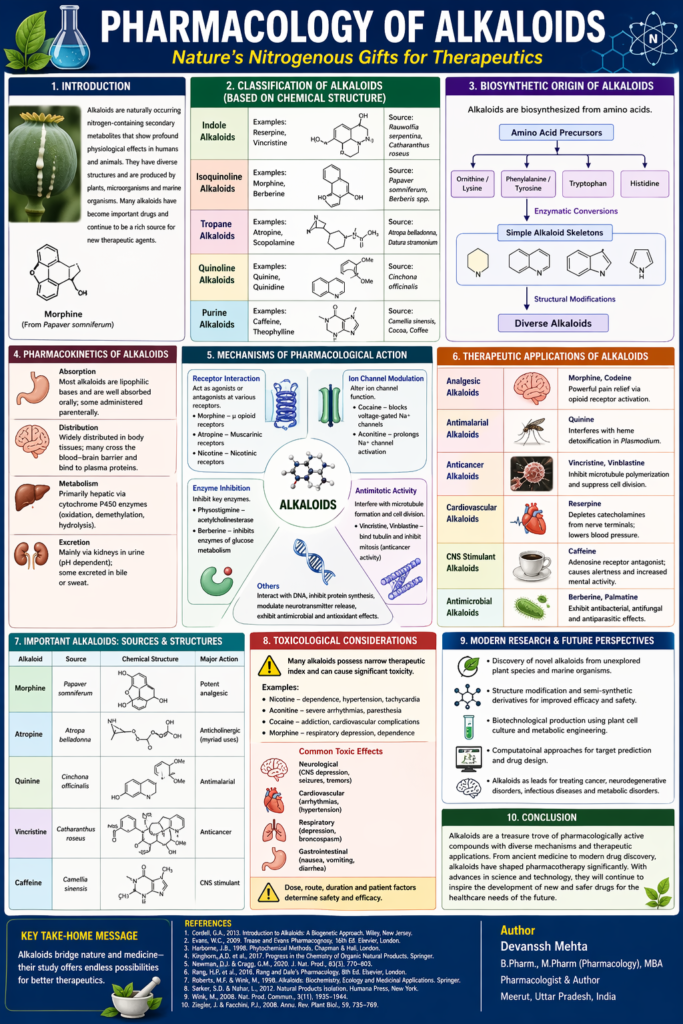
Abstract
Alkaloids represent one of the most pharmacologically significant classes of naturally occurring secondary metabolites. These nitrogen-containing organic compounds are primarily derived from plants but are also produced by microorganisms and marine organisms. Historically, alkaloids have served as the foundation of modern pharmacotherapy, providing numerous clinically important drugs including morphine, quinine, atropine, vincristine, and caffeine. The pharmacological actions of alkaloids are diverse, encompassing analgesic, antimalarial, anticancer, antimicrobial, antihypertensive, and central nervous system stimulatory effects. Their mechanisms of action often involve interaction with neurotransmitter receptors, modulation of ion channels, inhibition of enzymes, or interference with nucleic acid synthesis. Despite their therapeutic potential, alkaloids also exhibit significant toxicity and require careful pharmacological evaluation. This review article explores the chemistry, classification, pharmacokinetics, pharmacodynamics, and therapeutic applications of alkaloids, while also examining modern research developments and future prospects in alkaloid pharmacology. Understanding the pharmacological landscape of alkaloids remains critical for drug discovery, natural product research, and the development of novel therapeutic agents.
Keywords: Alkaloids, natural products, pharmacology, plant secondary metabolites, drug discovery, medicinal chemistry.
1. Introduction
Natural products have played a pivotal role in the development of modern pharmacology. Among these, alkaloids occupy a central position due to their remarkable structural diversity and potent biological activity. Alkaloids are nitrogen-containing organic compounds that exhibit significant pharmacological effects on humans and animals (Roberts and Wink, 1998). They are predominantly synthesized by plants as secondary metabolites and serve ecological roles such as defense against herbivores and microbial pathogens.
The term “alkaloid” was first introduced in the early nineteenth century following the isolation of morphine from the opium poppy by Friedrich Sertürner. Since then, hundreds of alkaloids have been identified from diverse botanical sources including Papaver somniferum, Rauwolfia serpentina, Cinchona officinalis, and Atropa belladonna. Many of these compounds have become indispensable in medicine.
Alkaloids exhibit complex pharmacological properties owing to their ability to interact with biological macromolecules such as receptors, enzymes, and nucleic acids. Their actions may involve modulation of neurotransmission, interference with cell division, inhibition of microbial growth, or regulation of cardiovascular functions (Cordell, 2013).
In contemporary pharmacological research, alkaloids continue to attract considerable attention as templates for novel drug development. Advances in biotechnology, metabolomics, and medicinal chemistry have further expanded the potential applications of these compounds.
This review aims to provide a comprehensive overview of the pharmacology of alkaloids, including their classification, mechanisms of action, pharmacokinetics, therapeutic applications, toxicity, and future research directions.
2. Chemical Nature and Classification of Alkaloids
Alkaloids are typically defined as basic nitrogen-containing organic compounds of plant origin that possess significant physiological activity. Most alkaloids are heterocyclic compounds containing nitrogen atoms within their ring structures.
2.1 Structural Characteristics
The defining chemical characteristics of alkaloids include:
- Presence of one or more nitrogen atoms
- Usually alkaline properties
- Complex ring structures
- Often derived from amino acid precursors
Their nitrogen atoms allow alkaloids to form salts with acids, which enhances their solubility in water and facilitates pharmacological activity.
2.2 Major Classes of Alkaloids
Alkaloids are commonly classified based on their chemical structure or biosynthetic origin.
2.2.1 Indole Alkaloids
Derived from the amino acid tryptophan, indole alkaloids include compounds such as:
- Reserpine
- Vincristine
- Vinblastine
- Ergotamine
These alkaloids are pharmacologically important due to their anticancer and antihypertensive activities.
2.2.2 Isoquinoline Alkaloids
Isoquinoline alkaloids include:
- Morphine
- Codeine
- Papaverine
- Berberine
These compounds exhibit analgesic, antimicrobial, and antispasmodic effects.
2.2.3 Tropane Alkaloids
Tropane alkaloids include:
- Atropine
- Hyoscyamine
- Scopolamine
- Cocaine
These alkaloids primarily affect the autonomic nervous system.
2.2.4 Quinoline Alkaloids
Quinoline alkaloids include:
- Quinine
- Quinidine
These compounds are particularly significant for antimalarial therapy.
2.2.5 Purine Alkaloids
Purine alkaloids include:
- Caffeine
- Theobromine
- Theophylline
These compounds act as central nervous system stimulants.
3. Pharmacokinetics of Alkaloids
The pharmacokinetic behavior of alkaloids plays a crucial role in determining their therapeutic effectiveness and toxicity.
3.1 Absorption
Most alkaloids are lipophilic bases, allowing them to be readily absorbed through biological membranes. Oral absorption is common, though some alkaloids are administered parenterally.
For example, morphine exhibits moderate oral bioavailability due to first-pass metabolism.
3.2 Distribution
Once absorbed, alkaloids are distributed throughout the body. Many alkaloids can cross the blood–brain barrier, enabling them to exert central nervous system effects.
Protein binding and tissue affinity influence their distribution patterns.
3.3 Metabolism
Alkaloids are primarily metabolized in the liver by cytochrome P450 enzymes. Biotransformation often involves:
- Oxidation
- Demethylation
- Hydrolysis
These metabolic processes convert alkaloids into more polar metabolites for excretion.
3.4 Excretion
Excretion occurs mainly via the kidneys, though some alkaloids may be eliminated through bile or sweat.
Urinary pH significantly influences the excretion of alkaloids due to their basic nature.
4. Pharmacodynamics and Mechanisms of Action
The pharmacological effects of alkaloids arise from their interaction with diverse molecular targets.
4.1 Interaction with Neurotransmitter Receptors
Many alkaloids act as agonists or antagonists of neurotransmitter receptors.
Examples include:
- Morphine acting on opioid receptors
- Atropine blocking muscarinic acetylcholine receptors
- Nicotine stimulating nicotinic receptors
These interactions produce profound physiological responses.
4.2 Ion Channel Modulation
Certain alkaloids influence ion channel activity.
For example:
- Cocaine blocks voltage-gated sodium channels
- Aconitine affects sodium channel activation
This mechanism explains their anesthetic or toxic effects.
4.3 Enzyme Inhibition
Some alkaloids exert pharmacological effects through enzyme inhibition.
For instance:
- Physostigmine inhibits acetylcholinesterase
- Berberine inhibits enzymes involved in glucose metabolism.
4.4 Antimitotic Activity
Several alkaloids interfere with cell division by binding to tubulin.
Examples include:
- Vincristine
- Vinblastine
These compounds disrupt microtubule formation, leading to inhibition of mitosis.
5. Therapeutic Applications of Alkaloids
Alkaloids have contributed enormously to modern therapeutics.
5.1 Analgesic Alkaloids
Morphine and codeine are among the most potent analgesics available.
Morphine exerts its analgesic effect through activation of μ-opioid receptors, resulting in inhibition of pain transmission pathways (Rang et al., 2016).
5.2 Antimalarial Alkaloids
Quinine was historically the first effective treatment for malaria.
It acts by interfering with the parasite’s heme detoxification pathway.
5.3 Anticancer Alkaloids
Plant-derived alkaloids such as vincristine and vinblastine have revolutionized cancer chemotherapy.
These drugs inhibit microtubule polymerization, thereby blocking mitosis in rapidly dividing cancer cells.
5.4 Cardiovascular Alkaloids
Reserpine from Rauwolfia serpentina was historically used as an antihypertensive agent.
It reduces blood pressure by depleting catecholamines from sympathetic nerve terminals.
5.5 Central Nervous System Stimulants
Purine alkaloids such as caffeine stimulate the central nervous system by antagonizing adenosine receptors, leading to increased neuronal activity.
6. Toxicological Considerations
Despite their therapeutic potential, alkaloids often exhibit significant toxicity.
Examples include:
- Nicotine toxicity
- Aconitine poisoning
- Cocaine addiction
Toxic effects may include:
- Neurological disturbances
- Cardiovascular toxicity
- Respiratory depression
Therefore, pharmacological use requires strict dose regulation.
7. Alkaloids in Modern Drug Discovery
The discovery of alkaloids has profoundly influenced medicinal chemistry.
Modern research focuses on:
- Structural modification of natural alkaloids
- Synthetic analog development
- Biotechnological production
Advances in metabolomics and genomic engineering have enabled the identification of novel alkaloid biosynthetic pathways.
8. Future Perspectives
The future of alkaloid pharmacology lies in the integration of natural product chemistry, molecular pharmacology, and biotechnology.
Potential research directions include:
- Discovery of new alkaloids from unexplored plant species
- Development of targeted anticancer alkaloids
- Use of synthetic biology to enhance alkaloid production
Furthermore, computational drug design may facilitate the development of alkaloid-derived therapeutic agents with improved efficacy and safety.
9. Conclusion
Alkaloids represent one of the most important classes of natural products in pharmacology. Their remarkable structural diversity and potent biological activities have led to the development of numerous life-saving drugs. From analgesics such as morphine to anticancer agents like vincristine, alkaloids continue to play a crucial role in modern medicine.
However, the therapeutic use of alkaloids must be carefully balanced against their potential toxicity. Continued research into alkaloid biosynthesis, pharmacodynamics, and medicinal chemistry will undoubtedly expand their role in drug discovery.
As global interest in plant-derived medicines continues to grow, alkaloids will remain a central focus of pharmacological research and pharmaceutical innovation.
References
Cordell, G.A., 2013. Introduction to Alkaloids: A Biogenetic Approach. New Jersey: Wiley.
Evans, W.C., 2009. Trease and Evans Pharmacognosy. 16th ed. London: Saunders Elsevier.
Harborne, J.B., 1998. Phytochemical Methods. London: Chapman and Hall.
Kinghorn, A.D., Falk, H., Kobayashi, J. and Gibbons, S., 2017. Progress in the Chemistry of Organic Natural Products. Cham: Springer.
Newman, D.J. and Cragg, G.M., 2020. Natural products as sources of new drugs. Journal of Natural Products, 83(3), pp.770-803.
Rang, H.P., Dale, M.M., Ritter, J.M. and Flower, R.J., 2016. Rang and Dale’s Pharmacology. 8th ed. London: Elsevier.
Roberts, M.F. and Wink, M., 1998. Alkaloids: Biochemistry, Ecology and Medicinal Applications. New York: Springer.
Sarker, S.D. and Nahar, L., 2012. Natural Products Isolation. New York: Humana Press.
Wink, M., 2008. Plant secondary metabolites modulate insect behavior. Natural Product Communications, 3(11), pp.1935-1944.
Ziegler, J. and Facchini, P.J., 2008. Alkaloid biosynthesis: metabolism and trafficking. Annual Review of Plant Biology, 59, pp.735-769.