

Author: Devanssh Mehta
B.Pharm., M.Pharm. (Pharmacology), MBA
Meerut, Uttar Pradesh, India
Abstract
Nash’s Equilibrium Theory represents one of the most influential conceptual frameworks in modern game theory and strategic decision-making. Introduced by mathematician John Nash in the early 1950s, the concept fundamentally transformed the understanding of competitive and cooperative behavior in economics, political science, evolutionary biology, and strategic management. Nash equilibrium describes a situation in which each participant in a strategic interaction chooses an optimal strategy given the strategies chosen by others, such that no player can benefit by unilaterally changing their decision. This equilibrium concept provides a powerful analytical lens for examining situations involving interdependent decision-making. From oligopolistic market competition to international diplomacy and evolutionary strategies in biology, Nash equilibrium has proven to be a universal analytical tool. This article presents a comprehensive review of Nash equilibrium theory, exploring its mathematical foundations, conceptual development, theoretical implications, real-world applications, limitations, and future directions in strategic sciences. Understanding Nash equilibrium remains essential for interpreting rational behavior in complex strategic environments.
Keywords: Nash equilibrium, game theory, strategic decision making, economic competition, rational behavior, mathematical economics.
1. Introduction
The study of strategic interaction among rational decision-makers forms the foundation of modern game theory. Within this intellectual framework, Nash equilibrium stands as one of the most important theoretical contributions to economics and strategic analysis. Developed by John Nash in 1950, the concept provided a generalized solution framework for non-cooperative games, fundamentally expanding upon earlier models introduced by John von Neumann and Oskar Morgenstern.
In real-world environments, individuals, corporations, governments, and biological organisms often operate in contexts where outcomes depend not only on their own decisions but also on the actions of others. Traditional economic models that assume isolated decision-making fail to capture the complexity of such interactions. Nash equilibrium offers a systematic method for analyzing these interdependent decisions.
The concept has profoundly influenced multiple disciplines including economics, political science, evolutionary biology, artificial intelligence, and behavioral sciences. Its importance was recognized globally when John Nash was awarded the Nobel Prize in Economic Sciences in 1994.
The objective of this article is to analyze Nash equilibrium theory in depth, including its conceptual origins, mathematical formulation, theoretical implications, applications, and limitations.
2. Historical Development of Nash Equilibrium
The intellectual roots of game theory can be traced to the groundbreaking work Theory of Games and Economic Behavior by John von Neumann and Oskar Morgenstern in 1944. Their work introduced mathematical models for analyzing strategic interactions but primarily focused on zero-sum games.
However, many real-world scenarios involve non-zero-sum interactions in which multiple participants may simultaneously gain or lose. Recognizing this limitation, John Nash introduced a new equilibrium concept that could apply to any strategic game involving rational players.
Nash’s doctoral dissertation in 1950 introduced the equilibrium concept now known as Nash equilibrium. His formulation demonstrated that every finite strategic game contains at least one equilibrium point in mixed strategies.
This discovery transformed game theory from a narrow mathematical curiosity into a central analytical tool in economics and social sciences.
3. Mathematical Formulation of Nash Equilibrium
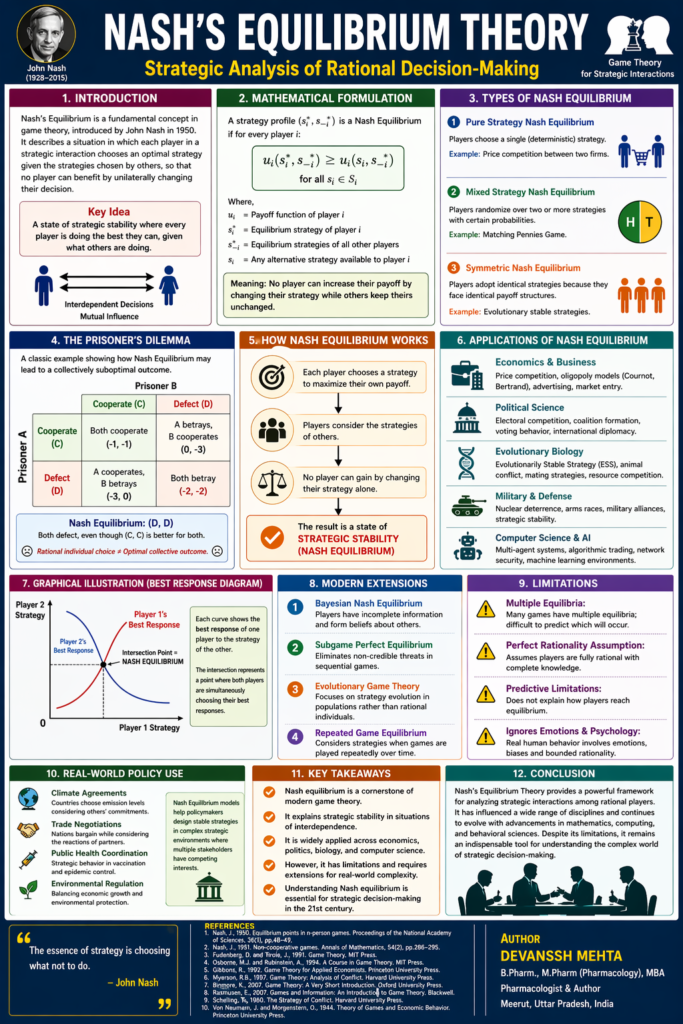
The central idea of Nash equilibrium is that each player’s strategy is optimal given the strategies chosen by all other players.
Mathematically, a Nash equilibrium occurs when no player can increase their payoff by changing their strategy while the strategies of other players remain unchanged.
The classical equilibrium condition can be expressed as:
ui(si∗,s−i∗)≥ui(si,s−i∗)
Where:
- ui = payoff function of player i
- si∗ = equilibrium strategy of player i
- s−i∗ = equilibrium strategies of all other players
- si = alternative strategy available to player i
This condition implies that no unilateral deviation can produce a better outcome for any participant.
4. Types of Nash Equilibria
Nash equilibria can appear in several forms depending on the structure of the game.
4.1 Pure Strategy Nash Equilibrium
A pure strategy equilibrium occurs when players choose deterministic strategies. In such cases, each participant selects a single action that represents their best response to the actions of others.
An example includes price competition between two firms in a duopoly market.
4.2 Mixed Strategy Nash Equilibrium
In some games, no pure strategy equilibrium exists. In such situations, players may adopt probabilistic strategies.
A mixed strategy equilibrium occurs when players randomize among multiple possible actions with specific probabilities.
The classic example is the Matching Pennies game, where each player’s optimal strategy involves randomization.
4.3 Symmetric Nash Equilibrium
A symmetric equilibrium arises when players adopt identical strategies because they face identical payoff structures.
This situation often occurs in evolutionary biology and population dynamics.
5. Conceptual Interpretation of Nash Equilibrium
At its core, Nash equilibrium represents a state of strategic stability.
In this equilibrium:
- Each player has chosen the best possible strategy
- Given the strategies of others
- No participant has an incentive to deviate
This stability concept explains why certain strategic outcomes persist even when they may not represent the collectively optimal solution.
6. The Prisoner’s Dilemma: A Classic Illustration
The most famous example illustrating Nash equilibrium is the Prisoner’s Dilemma.
Two suspects are interrogated separately and must decide whether to cooperate with each other or betray the other prisoner.
The payoff structure creates a situation in which both prisoners rationally choose to betray each other, even though mutual cooperation would produce a better collective outcome.
Thus, the equilibrium outcome becomes:
Both prisoners defect
This demonstrates a key insight of Nash equilibrium: rational individual decision-making does not always produce socially optimal outcomes.
7. Applications of Nash Equilibrium
The influence of Nash equilibrium extends far beyond theoretical economics.
7.1 Economic Competition
In oligopolistic markets, firms must consider the strategic responses of competitors.
Examples include:
- Price competition
- Advertising strategies
- Market entry decisions
The Cournot duopoly model and Bertrand competition model both incorporate Nash equilibrium principles.
7.2 Political Strategy
Political actors frequently engage in strategic interactions such as:
- Electoral competition
- Coalition formation
- International diplomacy
Game theoretic models using Nash equilibrium help explain strategic voting behavior and policy negotiation outcomes.
7.3 Evolutionary Biology
In evolutionary biology, Nash equilibrium corresponds to the concept of Evolutionarily Stable Strategy (ESS).
Organisms adopt behavioral strategies that cannot be invaded by alternative strategies within a population.
This framework has been used to explain:
- Animal conflict behavior
- Resource competition
- Mating strategies
7.4 Military and Strategic Defense
Game theory has historically played a major role in defense strategy, particularly during the Cold War.
Nash equilibrium concepts help analyze:
- Nuclear deterrence
- Strategic arms races
- Military alliances
Mutual deterrence can be interpreted as a Nash equilibrium in strategic military interaction.
7.5 Artificial Intelligence and Computer Science
Modern AI systems frequently rely on game-theoretic principles.
Applications include:
- Multi-agent systems
- Algorithmic trading
- Network security
- Machine learning optimization
Nash equilibrium helps design algorithms that operate efficiently in competitive environments.
8. Limitations of Nash Equilibrium
Despite its theoretical importance, Nash equilibrium also has significant limitations.
8.1 Multiple Equilibria Problem
Many games possess multiple equilibrium points. Determining which equilibrium will emerge in practice can be difficult.
8.2 Assumption of Perfect Rationality
Nash equilibrium assumes that players are perfectly rational and possess full knowledge of the game structure.
In reality, human decision-making often involves bounded rationality and incomplete information.
8.3 Lack of Predictive Power in Some Situations
While Nash equilibrium describes stable outcomes, it does not always predict how players will reach equilibrium.
Dynamic adjustment processes may differ significantly across real-world systems.
9. Modern Extensions of Nash Equilibrium
Contemporary research has extended Nash equilibrium in several important directions.
9.1 Bayesian Nash Equilibrium
In situations involving incomplete information, players may hold probabilistic beliefs about others’ strategies.
Bayesian Nash equilibrium incorporates uncertainty into strategic analysis.
9.2 Subgame Perfect Equilibrium
Developed by Reinhard Selten, this refinement eliminates non-credible threats in sequential games.
It ensures that strategies remain optimal at every stage of the game.
9.3 Evolutionary Game Theory
Evolutionary game theory analyzes strategy evolution in populations rather than rational decision-making individuals.
This framework has been widely applied in biology and economics.
10. Nash Equilibrium in Real-World Policy Analysis
Modern policymakers frequently use game theory models to evaluate strategic interactions in areas such as:
- Environmental regulation
- Trade negotiations
- Climate agreements
- Public health coordination
These models help identify stable policy outcomes under competing national interests.
11. Future Perspectives
The future of Nash equilibrium research lies in integrating game theory with emerging disciplines such as:
- Artificial intelligence
- Behavioral economics
- Network theory
- Computational social science
Advances in computational modeling now allow researchers to simulate complex multi-agent strategic environments with unprecedented precision.
These developments will continue expanding the relevance of Nash equilibrium in understanding complex systems.
12. Conclusion
Nash equilibrium represents one of the most profound intellectual contributions to modern strategic analysis. By providing a rigorous framework for analyzing interdependent decision-making, the concept has transformed fields ranging from economics and political science to biology and artificial intelligence.
Although the theory has limitations—particularly regarding assumptions of rationality and equilibrium selection—it remains an indispensable analytical tool for understanding strategic behavior.
As global systems become increasingly interconnected and competitive, the insights provided by Nash equilibrium will continue to shape the study of strategic decision-making in the twenty-first century.
References (Harvard Style)
Binmore, K., 2007. Game Theory: A Very Short Introduction. Oxford: Oxford University Press.
Fudenberg, D. and Tirole, J., 1991. Game Theory. Cambridge: MIT Press.
Gibbons, R., 1992. Game Theory for Applied Economists. Princeton: Princeton University Press.
Myerson, R.B., 1997. Game Theory: Analysis of Conflict. Cambridge: Harvard University Press.
Nash, J., 1950. Equilibrium points in n-person games. Proceedings of the National Academy of Sciences, 36(1), pp.48–49.
Nash, J., 1951. Non-cooperative games. Annals of Mathematics, 54(2), pp.286–295.
Osborne, M.J. and Rubinstein, A., 1994. A Course in Game Theory. Cambridge: MIT Press.
Rasmusen, E., 2007. Games and Information. Oxford: Blackwell.
Schelling, T., 1960. The Strategy of Conflict. Cambridge: Harvard University Press.
Von Neumann, J. and Morgenstern, O., 1944. Theory of Games and Economic Behavior. Princeton: Princeton University Press.