

Author: Devanssh Mehta
M.Pharm (Pharmacology), MBA, B.Pharm
Pharmacologist | Author | Researcher
Meerut, Uttar Pradesh, India
Abstract
Governance represents one of the most fundamental pillars of organized human society, shaping the interaction between institutions, citizens, and policy frameworks. In the modern era, governance has evolved from traditional bureaucratic administration toward a complex, multi-dimensional system influenced by globalization, technological advancement, economic transformation, and social expectations. The concept of governing dynamics refers to the evolving processes, institutional mechanisms, and strategic interactions that influence how governments formulate policies, implement decisions, and respond to societal challenges.
Effective governance is no longer limited to state authority alone; rather, it involves a network of actors including governmental institutions, civil society organizations, private sector stakeholders, and international bodies. The dynamics of governance are therefore shaped by political leadership, administrative capacity, regulatory structures, economic policies, and citizen participation. These interconnected elements collectively determine the efficiency, accountability, transparency, and legitimacy of governance systems.
This review article provides a comprehensive examination of governing dynamics by analyzing the theoretical foundations of governance, institutional structures, policy-making mechanisms, and emerging challenges in contemporary governance systems. The article also explores the role of digital governance, participatory decision-making, regulatory frameworks, and global governance institutions in shaping modern administrative processes. Furthermore, the review highlights the importance of adaptive governance strategies capable of responding to complex societal problems such as climate change, public health crises, economic inequality, and technological disruption.
Understanding the dynamics of governance is essential for designing resilient political institutions, improving policy outcomes, and strengthening democratic accountability. By integrating theoretical insights with practical governance frameworks, this article aims to contribute to the broader discourse on effective governance and sustainable policy development in the twenty-first century.
Keywords
Governance; public policy; institutional dynamics; political systems; strategic governance
Introduction
Governance has long been recognized as a fundamental component of human civilization. From ancient kingdoms and city-states to modern nation-states, governance structures have evolved to organize societies, regulate economic activity, maintain public order, and promote collective welfare. In contemporary political science and public administration, governance extends beyond the traditional functions of government to encompass a broader framework of decision-making processes involving multiple actors and institutions.
The concept of governing dynamics refers to the complex interactions between political leadership, institutional frameworks, regulatory systems, and societal forces that shape the functioning of governance systems. These dynamics influence how policies are formulated, how resources are allocated, and how governments respond to emerging social, economic, and environmental challenges.
Historically, governance was often associated with hierarchical authority structures in which decision-making power was concentrated within centralized political institutions. Monarchies, colonial administrations, and early bureaucratic states operated primarily through top-down governance models. While such systems provided administrative stability, they often lacked mechanisms for citizen participation and accountability.
The emergence of democratic political systems during the twentieth century fundamentally transformed governance structures. Democratic governance introduced principles such as representation, rule of law, transparency, and accountability into public administration. These principles emphasized the importance of citizen participation and institutional checks and balances in shaping governance outcomes.
However, modern governance systems face increasing complexity due to globalization, technological transformation, and interconnected economic systems. Governments must now navigate a wide range of policy challenges that transcend national borders, including climate change, global health crises, financial instability, and cybersecurity threats. These challenges require governance approaches that are flexible, collaborative, and adaptive.
One of the defining characteristics of contemporary governance is the growing role of multi-level governance. In this model, decision-making authority is distributed across different levels of government, including local, regional, national, and international institutions. For example, environmental policies may involve cooperation between municipal governments, national regulatory agencies, and international organizations.
Another important dimension of governing dynamics is the increasing involvement of non-state actors in policy processes. Civil society organizations, private corporations, academic institutions, and international agencies now play significant roles in shaping public policy. These actors contribute expertise, financial resources, and innovative solutions to complex policy challenges.
Technological innovation has also transformed governance mechanisms. Digital technologies such as artificial intelligence, big data analytics, and blockchain are increasingly being integrated into governance processes to improve transparency, efficiency, and service delivery. The emergence of digital governance has enabled governments to interact more effectively with citizens through online platforms and electronic public services.
In addition to technological developments, economic globalization has reshaped the dynamics of governance. National governments must now coordinate with international financial institutions, trade organizations, and multinational corporations to manage economic policies and maintain global economic stability.
Despite these advancements, governance systems continue to face significant challenges. Issues such as corruption, bureaucratic inefficiency, political polarization, and inequality can undermine public trust in government institutions. Addressing these challenges requires governance frameworks that emphasize accountability, ethical leadership, and institutional resilience.
From a strategic perspective, effective governance requires the integration of political leadership, administrative expertise, and evidence-based policymaking. Governments must balance competing interests, manage limited resources, and respond to rapidly changing societal needs.
The study of governing dynamics therefore represents an interdisciplinary field encompassing political science, public administration, economics, sociology, and law. Understanding the mechanisms that drive governance systems is essential for designing policies that promote social stability, economic prosperity, and sustainable development.
The objective of this review article is to examine the theoretical foundations, institutional structures, and strategic mechanisms that define governing dynamics in contemporary political systems. By synthesizing insights from governance theory and practical policy analysis, this article seeks to provide a comprehensive perspective on the evolving nature of governance in the modern world.
Theoretical Foundations of Governance
Governance theory has evolved significantly over the past several decades. Early models of governance focused primarily on hierarchical state authority and bureaucratic administration. However, contemporary governance theory recognizes the importance of networks, collaboration, and decentralized decision-making.
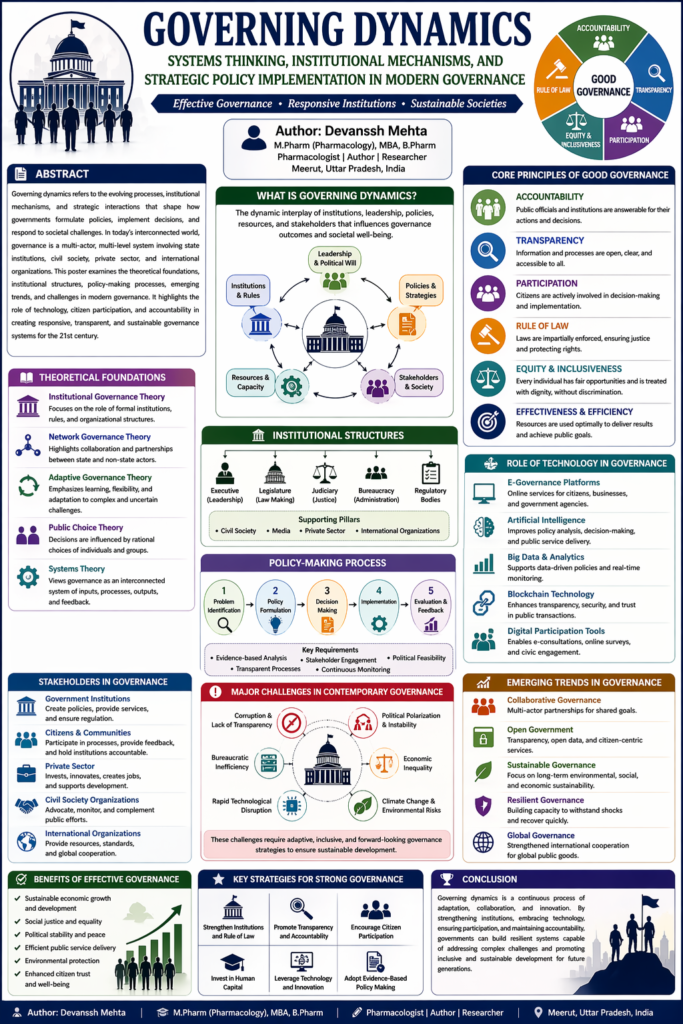
Key governance theories include:
Institutional Governance Theory
This theory emphasizes the role of formal institutions such as legislatures, courts, and administrative agencies in shaping governance outcomes.
Network Governance Theory
Network governance focuses on collaborative relationships between government agencies, private organizations, and civil society.
Adaptive Governance Theory
Adaptive governance emphasizes flexibility and learning in policy-making processes to address complex and evolving challenges.
Institutional Structures in Governance
Modern governance systems operate through multiple institutional mechanisms, including:
• Executive leadership
• Legislative institutions
• Judicial systems
• Administrative agencies
• Regulatory bodies
These institutions collectively ensure policy formulation, implementation, and oversight.
Policy-Making Processes
Policy-making typically involves several stages:
- Problem identification
- Policy formulation
- Decision-making
- Policy implementation
- Evaluation and feedback
Effective policy processes require evidence-based decision-making and stakeholder engagement.
Role of Technology in Governance
Digital technologies are transforming governance through innovations such as:
• E-governance platforms
• Artificial intelligence in public administration
• Data-driven policy analysis
• Blockchain-based transparency systems
These technologies enhance efficiency and accountability in government operations.
Challenges in Contemporary Governance
Governance systems face numerous challenges including:
• Political polarization
• Corruption and lack of transparency
• Economic inequality
• Environmental crises
• Rapid technological disruption
Addressing these issues requires strategic governance reforms.
Future Perspectives in Governance
Future governance models are expected to emphasize:
• Collaborative policy-making
• Evidence-based governance
• Digital transformation
• Sustainable development policies
Conclusion
The dynamics of governance continue to evolve in response to changing social, economic, and technological conditions. Effective governance requires adaptive institutions, transparent decision-making processes, and active citizen participation. Strengthening governance systems will remain a critical priority for achieving sustainable development and social stability in the twenty-first century.
References (Harvard Style)
Rhodes, R.A.W., 2017. Network Governance and Public Administration. Oxford University Press.
Kooiman, J., 2003. Governing as Governance. London: Sage Publications.
Pierre, J. and Peters, B.G., 2000. Governance, Politics and the State. London: Macmillan.
World Bank, 2020. Worldwide Governance Indicators. Washington DC: World Bank.