

Author: Devanssh Mehta
M.Pharm (Pharmacology), MBA, B.Pharm
Pharmaceutical Author and Research Scholar, Meerut, India
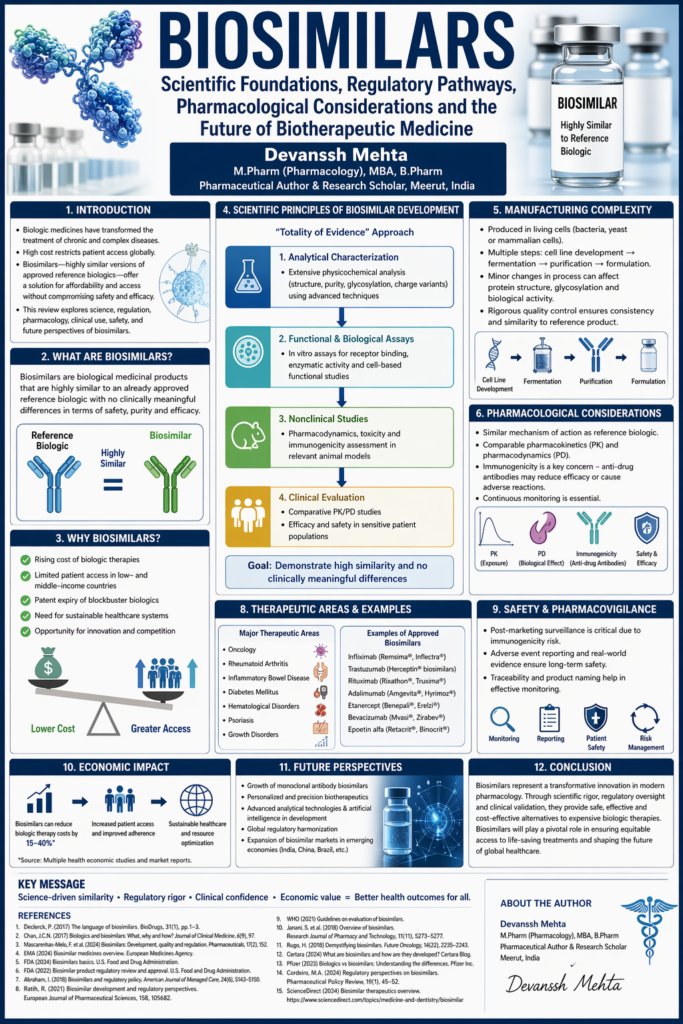
Abstract
The emergence of biologic medicines has revolutionized modern therapeutics, transforming the treatment landscape for chronic diseases such as cancer, autoimmune disorders, diabetes, and inflammatory diseases. However, the high cost of biologics has created substantial barriers to healthcare accessibility worldwide. Biosimilars—biological medicinal products that are highly similar to already approved reference biologics—have emerged as an innovative pharmaceutical solution designed to enhance therapeutic accessibility while maintaining equivalent safety, efficacy, and quality. This review explores the scientific foundations, pharmacological principles, regulatory frameworks, manufacturing complexities, clinical evaluation, pharmacovigilance requirements, and global economic implications of biosimilars. The article examines how biosimilar development differs fundamentally from traditional generic drug production due to the complexity of biologics, including structural heterogeneity, manufacturing variability, and immunogenicity risks. Furthermore, regulatory pathways established by major agencies such as the European Medicines Agency (EMA), the United States Food and Drug Administration (FDA), and the World Health Organization (WHO) are analyzed. Finally, the review discusses emerging trends such as monoclonal antibody biosimilars, interchangeability, global market expansion, and India’s strategic role in biosimilar development. Biosimilars represent one of the most transformative developments in modern pharmacology, capable of reshaping global healthcare economics while expanding patient access to life-saving biologic therapies.
Keywords: Biosimilars, biologics, regulatory science, pharmacology, immunogenicity, biotherapeutics, biosimilar development.
1. Introduction
Biological medicines have dramatically altered the landscape of therapeutic medicine over the past three decades. These complex pharmaceutical agents, derived from living organisms through advanced biotechnological processes, have enabled the treatment of diseases that were previously difficult or impossible to manage. Therapeutic monoclonal antibodies, recombinant proteins, growth factors, and cytokines represent major categories of biologics that have demonstrated profound clinical effectiveness in oncology, immunology, endocrinology, and rare genetic disorders.
However, despite their remarkable therapeutic benefits, biologics remain among the most expensive pharmaceutical products available in the global healthcare market. The manufacturing complexity associated with biotechnology-derived medicines results in substantial development and production costs. Consequently, access to biologic therapies is frequently limited in low- and middle-income countries, creating disparities in healthcare accessibility.
The concept of biosimilars emerged as a strategic response to this challenge. Biosimilars are biological medicinal products that are highly similar to an already approved reference biologic, demonstrating no clinically meaningful differences in terms of safety, purity, or efficacy (Declerck, 2017; FDA, 2024).
Unlike conventional generic drugs, biosimilars cannot be considered exact copies of their reference products because biologics possess highly complex molecular structures and are produced using living systems. Instead, biosimilars must demonstrate similarity through extensive analytical, nonclinical, and clinical comparisons with the reference biologic (Mascarenhas-Melo et al., 2024).
The development of biosimilars represents one of the most significant transformations in pharmaceutical science and healthcare economics. By enabling competition after patent expiry of innovator biologics, biosimilars hold the potential to reduce treatment costs, increase patient access, and stimulate innovation in biopharmaceutical development.
This review article aims to provide a comprehensive scientific examination of biosimilars, focusing on their pharmacological basis, regulatory frameworks, manufacturing challenges, clinical evaluation, and future implications for global healthcare.
2. Biological Medicines and the Emergence of Biosimilars
Biologics are therapeutic products derived from living organisms or produced through recombinant DNA technology. These medicines include monoclonal antibodies, recombinant hormones, enzymes, cytokines, and vaccines. Due to their biological origin, biologics exhibit large molecular sizes, complex tertiary structures, and post-translational modifications that distinguish them from traditional small-molecule drugs.
Small-molecule drugs are chemically synthesized compounds with relatively simple molecular structures that can be replicated precisely through chemical synthesis. In contrast, biologics are produced within living cells, resulting in inherent variability between production batches. This complexity makes exact replication impossible, which is why biosimilars are defined as “highly similar” rather than identical to the reference biologic (EMA, 2024).
The concept of biosimilars gained prominence after the expiration of patents on major biologic drugs such as erythropoietin, insulin analogues, interferons, and monoclonal antibodies. The increasing demand for cost-effective biologic therapies prompted regulatory agencies to establish specific approval pathways for biosimilars.
The European Union pioneered biosimilar regulation in 2006 when the European Medicines Agency approved the first biosimilar product, Omnitrope, a recombinant human growth hormone. Since then, biosimilars have become a rapidly expanding segment of the pharmaceutical market, with numerous products approved globally.
The scientific rationale behind biosimilar development is based on the concept of comparability. Instead of independently demonstrating safety and efficacy through extensive clinical trials, biosimilar manufacturers rely on a stepwise comparison with the reference product using analytical characterization, functional assays, and targeted clinical studies.
This approach significantly reduces development costs while maintaining stringent scientific standards.
3. Scientific Principles Underlying Biosimilar Development
The development of biosimilars relies on a fundamental principle known as the “totality of evidence” approach. This scientific framework involves a stepwise evaluation process designed to establish similarity between the biosimilar candidate and the reference biologic.
The process begins with extensive physicochemical characterization of the molecular structure. Advanced analytical techniques such as mass spectrometry, nuclear magnetic resonance spectroscopy, chromatography, and electrophoresis are used to evaluate molecular weight, glycosylation patterns, tertiary structure, and purity.
Biological activity is assessed through functional assays that evaluate receptor binding, enzymatic activity, and cellular responses. These assays ensure that the biosimilar exhibits equivalent pharmacological activity to the reference product.
Following analytical evaluation, nonclinical studies are conducted to assess toxicity, pharmacodynamics, and immunogenic potential in animal models. Although these studies are generally less extensive than those required for new biologic drugs, they play a crucial role in confirming biological similarity.
Clinical evaluation represents the final stage of biosimilar development. Comparative clinical trials are conducted to demonstrate equivalent pharmacokinetics, pharmacodynamics, safety, and efficacy between the biosimilar and the reference biologic.
The overall objective of biosimilar development is not to independently re-establish therapeutic efficacy but rather to confirm that the biosimilar behaves in a clinically indistinguishable manner compared with the reference product.
4. Manufacturing Complexity of Biosimilars
Manufacturing represents one of the most challenging aspects of biosimilar development. Biological medicines are produced using living cells such as bacteria, yeast, or mammalian cell cultures. These cells are genetically engineered to produce therapeutic proteins through recombinant DNA technology.
The production process involves multiple steps, including cell line development, fermentation, purification, and formulation. Each stage of manufacturing can influence the structural characteristics of the final product.
Minor variations in manufacturing conditions—such as temperature, nutrient composition, or purification techniques—can alter glycosylation patterns, protein folding, or aggregation states. These changes may affect biological activity or immunogenicity.
Because of this complexity, biosimilar manufacturers must design production processes that replicate the functional characteristics of the reference biologic as closely as possible.
Regulatory agencies require extensive analytical comparison to ensure that any differences between the biosimilar and reference product are not clinically meaningful.
5. Pharmacological Characteristics of Biosimilars
The pharmacological behavior of biosimilars is fundamentally determined by the structure and biological activity of the therapeutic protein.
Unlike small-molecule drugs that act through simple receptor interactions, biologics typically exert their therapeutic effects through complex molecular mechanisms. These mechanisms may include receptor binding, immune modulation, enzyme replacement, or cytokine signaling.
Biosimilars must demonstrate equivalent pharmacokinetic and pharmacodynamic profiles compared with the reference biologic. Pharmacokinetic studies evaluate parameters such as absorption, distribution, metabolism, and elimination.
Pharmacodynamic studies assess the biological effects of the drug, including biomarker responses and clinical outcomes.
Immunogenicity represents a critical pharmacological concern for biologics and biosimilars. Because therapeutic proteins can be recognized as foreign by the immune system, they may induce the formation of anti-drug antibodies.
These antibodies can neutralize the therapeutic effect of the drug or cause adverse immune reactions. Consequently, immunogenicity assessment is a key component of biosimilar clinical evaluation.
6. Regulatory Frameworks for Biosimilar Approval
Regulatory agencies worldwide have established specific guidelines for biosimilar approval. These frameworks aim to ensure that biosimilars maintain the same safety and efficacy standards as the reference biologic.
The European Medicines Agency pioneered biosimilar regulation and remains a global leader in this field. EMA guidelines emphasize a comprehensive comparability exercise involving analytical, nonclinical, and clinical studies.
In the United States, biosimilars are approved under the Biologics Price Competition and Innovation Act (BPCI Act), which established an abbreviated regulatory pathway for biosimilar products (Abraham, 2018).
The FDA requires biosimilar manufacturers to demonstrate that their product is highly similar to the reference biologic with no clinically meaningful differences in safety or effectiveness (FDA, 2024).
The World Health Organization has also developed international guidelines to facilitate biosimilar approval in emerging pharmaceutical markets.
7. Clinical Applications of Biosimilars
Biosimilars are widely used across several therapeutic areas, including:
- Oncology
- Rheumatoid arthritis
- Inflammatory bowel disease
- Diabetes mellitus
- Hematological disorders
Monoclonal antibody biosimilars represent one of the most rapidly growing segments of the biosimilar market. These therapies target specific immune pathways involved in inflammatory diseases and cancer.
Examples include biosimilars of:
- Infliximab
- Trastuzumab
- Rituximab
- Adalimumab
These drugs have demonstrated comparable clinical outcomes to their reference biologics in multiple randomized clinical trials.
8. Pharmacovigilance and Safety Monitoring
Post-marketing surveillance is essential for biosimilars due to the potential risk of immunogenicity and long-term adverse effects.
Pharmacovigilance programs monitor safety outcomes after biosimilar approval and ensure that any unexpected adverse reactions are promptly detected.
Healthcare professionals play a critical role in biosimilar pharmacovigilance through adverse event reporting and patient monitoring.
9. Economic Impact of Biosimilars
One of the most significant advantages of biosimilars is their potential to reduce healthcare costs.
Biologics represent a rapidly growing share of pharmaceutical expenditures worldwide. Biosimilars introduce market competition, which can lead to substantial price reductions.
Studies suggest that biosimilars may reduce biologic therapy costs by 15–40%, thereby improving patient access to life-saving treatments.
10. Future Perspectives
The future of biosimilars is closely linked to advances in biotechnology and regulatory science.
Emerging areas of biosimilar research include:
- Monoclonal antibody biosimilars
- Personalized biotherapeutics
- Artificial intelligence-driven drug development
- Global regulatory harmonization
Countries such as India and South Korea are rapidly becoming global leaders in biosimilar production.
India, in particular, possesses significant potential due to its strong biotechnology sector and cost-efficient pharmaceutical manufacturing capabilities.
11. Conclusion
Biosimilars represent a transformative innovation in modern pharmacology and pharmaceutical science. By providing cost-effective alternatives to expensive biologic therapies, biosimilars have the potential to expand global healthcare access while maintaining rigorous standards of safety and efficacy.
Although biosimilar development presents significant scientific and regulatory challenges, advances in analytical technologies, biotechnology, and regulatory frameworks continue to facilitate their successful integration into clinical practice.
As biologic therapies become increasingly central to modern medicine, biosimilars will play a critical role in ensuring equitable access to advanced treatments worldwide.
References
Abraham, I. (2018) Biosimilars and regulatory policy. American Journal of Managed Care.
Chan, J.C.N. (2017) Biologics and biosimilars: What, why and how? Journal of Clinical Medicine.
Declerck, P. (2017) The language of biosimilars. BioDrugs.
EMA (2024) Biosimilar medicines overview. European Medicines Agency.
FDA (2024) Biosimilars basics. U.S. Food and Drug Administration.
FDA (2022) Biosimilar product regulatory review and approval. FDA.
Mascarenhas-Melo, F. et al. (2024) Biosimilars: Development, quality and regulation. Pharmaceuticals.
Ratih, R. (2021) Biosimilar development and regulatory perspectives. European Journal of Pharmaceutical Sciences.
WHO (2021) Guidelines on evaluation of biosimilars.
Janani, S. et al. (2018) Overview of biosimilars. Research Journal of Pharmacy and Technology.
Rugo, H. (2018) Demystifying biosimilars. Future Oncology.
Certara (2024) Biosimilar development and regulatory science.
Pfizer (2023) Biologics vs biosimilars.
ScienceDirect (2024) Biosimilar therapeutics overview.
Cordeiro, M.A. (2024) Regulatory perspectives on biosimilars. Pharmaceutical Policy Review.