

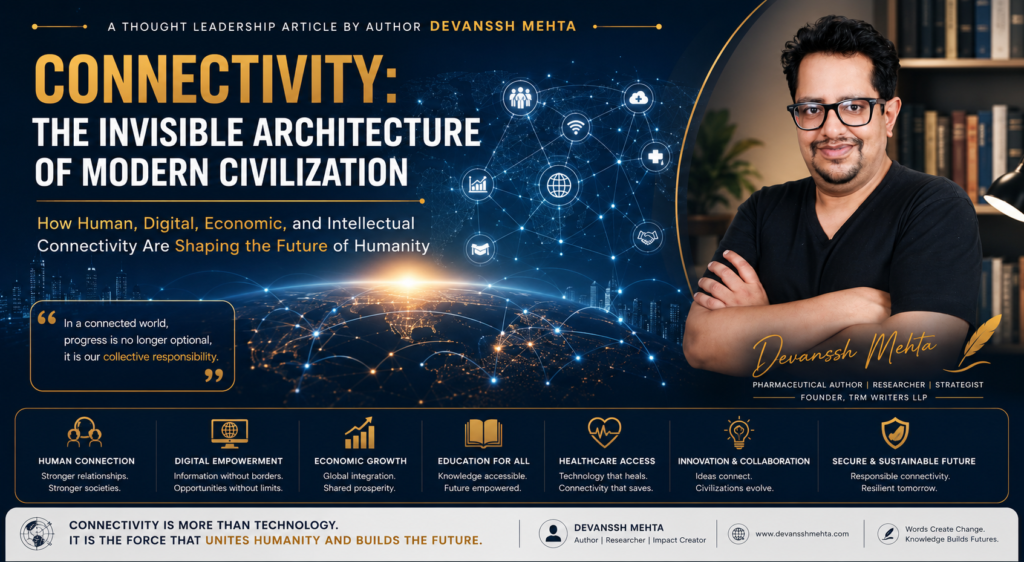
How Human, Digital, Economic, and Intellectual Connectivity Are Shaping the Future of Humanity
By Devanssh Mehta
Introduction
Human civilization has always evolved through connectivity. From the earliest tribal communications around fire to modern satellite-based digital networks, the story of humanity is fundamentally the story of connection. Every major transformation in civilization — agriculture, trade, industrialization, science, globalization, and digitalization — became possible because human beings found new ways to connect with each other.
In the twenty-first century, connectivity has emerged not merely as a technological concept, but as the foundational architecture of modern civilization itself. Nations are connected through economic systems. Individuals are connected through digital platforms. Scientists collaborate across continents. Businesses operate globally in real time. Families communicate instantly regardless of geography. Knowledge moves faster than ever before. Ideas now travel more rapidly than armies.
The modern world no longer functions through isolated systems. Instead, it operates through deeply interconnected networks of communication, transportation, information, finance, healthcare, education, and technology. Connectivity today determines economic competitiveness, national security, innovation capability, healthcare access, social mobility, and even geopolitical influence.
A disconnected society risks stagnation. A connected society creates opportunity.
The importance of connectivity has become even more evident after global crises such as the COVID-19 pandemic, where digital communication, telemedicine, online education, logistics networks, pharmaceutical collaborations, and global scientific partnerships demonstrated how interconnected systems can sustain civilization during emergencies. Connectivity became survival.
However, connectivity is not only about the internet or smartphones. It represents a multidimensional force that influences every domain of human life. It includes emotional connectivity between people, intellectual connectivity between institutions, economic connectivity between nations, technological connectivity between systems, and strategic connectivity between civilizations.
The future belongs not merely to powerful nations, but to connected nations. Similarly, the future belongs not only to intelligent individuals, but to individuals capable of meaningful connection, collaboration, adaptability, and communication.
This article explores the profound importance of connectivity in today’s modern world from social, technological, economic, educational, healthcare, strategic, ethical, and civilizational perspectives.
Historical Evolution of Connectivity
Connectivity is not a modern invention. It is deeply embedded in human evolution.
Primitive humans survived through tribal cooperation and communication. Ancient civilizations such as Mesopotamia, Egypt, India, China, Greece, and Rome expanded through trade routes, maritime exploration, and cultural exchanges. The Silk Route connected Asia to Europe and became one of history’s greatest examples of economic and intellectual connectivity.
India historically flourished because of connectivity through maritime trade, philosophical exchange, educational institutions like Nalanda and Takshashila, and cultural integration.
The Industrial Revolution accelerated connectivity through railways, telegraphs, and mechanized transportation. The twentieth century introduced telephones, radio, television, aviation, and eventually computers.
The internet revolution fundamentally transformed civilization by eliminating many physical limitations of communication.
Today humanity stands at the threshold of hyperconnectivity — an era where artificial intelligence, cloud computing, 5G networks, satellite internet, blockchain systems, digital economies, and intelligent infrastructures are creating an interconnected planetary ecosystem.
Connectivity has evolved from physical roads to digital highways.
Digital Connectivity: The Nervous System of Modern Civilization
Digital connectivity has become the most transformative force of the modern era.
The internet today functions as the nervous system of global civilization. Information flows continuously across borders, industries, governments, institutions, and individuals. Businesses rely on cloud computing. Students depend on online education. Governments provide digital governance. Scientists collaborate through virtual platforms.
Digital connectivity has transformed:
- Communication
- Education
- Healthcare
- Banking
- Research
- Entertainment
- Commerce
- Governance
- Defense
- Media
- Innovation ecosystems
A smartphone today possesses more communication power than entire governments possessed decades ago.
Digital connectivity has democratized information access. A student in a small Indian town can now learn from global universities. A startup entrepreneur can access international markets. Researchers can publish globally. Authors can self-publish digitally.
This transformation has reduced geographical inequality to some extent.
However, digital connectivity is also creating new challenges:
- Information overload
- Cybercrime
- Digital addiction
- Data privacy concerns
- Misinformation
- Psychological isolation despite online presence
- Digital surveillance
- Technological dependency
Therefore, connectivity must evolve alongside digital ethics and responsible governance.
Human Connectivity: The Emotional Foundation of Society
Despite technological advancement, human connectivity remains the emotional core of civilization.
Modern societies are becoming increasingly fast-paced, competitive, and digitally absorbed. Yet emotional relationships remain essential for psychological stability, mental health, and social harmony.
Human beings are biologically social creatures. Emotional isolation damages mental well-being. Meaningful relationships enhance resilience, happiness, creativity, and longevity.
Connectivity between families, communities, and societies strengthens civilization.
In today’s modern world:
- Families communicate across continents
- Friends maintain relationships digitally
- Professional collaborations occur globally
- Support systems operate online and offline simultaneously
However, paradoxically, the digital age has also increased loneliness in many societies.
People are constantly connected technologically but emotionally disconnected internally.
This contradiction reveals an important truth:
True connectivity is not merely technological access; it is meaningful human engagement.
Civilization cannot survive on algorithms alone. It requires empathy, compassion, trust, emotional intelligence, and social responsibility.
The future of connectivity must therefore integrate technological efficiency with human sensitivity.
Economic Connectivity and Globalization
Modern economies function through interconnected global systems.
No major economy today operates in complete isolation. Supply chains, financial markets, logistics systems, manufacturing networks, trade agreements, and digital commerce create a highly interconnected economic ecosystem.
Economic connectivity enables:
- International trade
- Foreign investments
- Innovation exchange
- Industrial partnerships
- Employment generation
- Technological transfer
- Global entrepreneurship
India’s rise as an economic power is closely linked to globalization and connectivity. Indian IT professionals, pharmaceutical industries, startups, digital payment systems, and service sectors have benefited enormously from global integration.
The pharmaceutical industry provides an excellent example.
A single medicine may involve:
- Research in one country
- API manufacturing in another
- Clinical trials elsewhere
- Packaging in another region
- Global distribution through multinational logistics systems
Connectivity enables healthcare accessibility at a global scale.
However, excessive dependency on interconnected systems also creates vulnerabilities. The COVID-19 pandemic exposed disruptions in supply chains, API dependency, semiconductor shortages, and healthcare logistics.
Therefore, modern nations must build “strategic connectivity” rather than “fragile dependency.”
Resilient connectivity is more important than uncontrolled globalization.
Connectivity in Healthcare
Healthcare connectivity has transformed medicine profoundly.
Modern healthcare increasingly depends upon interconnected systems:
- Electronic medical records
- Telemedicine
- AI-assisted diagnostics
- Global disease surveillance
- Pharmaceutical supply chains
- Genomic databases
- International medical collaborations
During the COVID-19 pandemic, connectivity saved millions of lives.
Scientists worldwide collaborated rapidly. Research papers were shared instantly. Vaccine data moved globally. Healthcare advisories spread digitally. Telemedicine expanded dramatically.
Connectivity accelerated vaccine development timelines that historically required many years.
Digital healthcare connectivity is particularly important for countries like India, where rural populations often lack specialist access.
Telemedicine can reduce geographical healthcare inequalities.
Future healthcare will depend heavily upon:
- AI-driven connectivity
- Wearable health monitoring
- Remote diagnostics
- Cloud-based healthcare systems
- Personalized medicine platforms
- Genomic integration networks
However, healthcare connectivity also raises ethical concerns regarding patient privacy, medical data security, algorithmic bias, and commercialization of healthcare information.
Healthcare systems must therefore balance innovation with ethics.
Educational Connectivity and Knowledge Democratization
Education is undergoing a revolutionary transformation through connectivity.
Historically, knowledge was geographically restricted. Today, digital platforms have democratized learning access.
Students can now:
- Attend virtual classes
- Access international journals
- Learn from global experts
- Participate in online certifications
- Conduct collaborative research
- Publish internationally
Connectivity has reduced educational barriers significantly.
The rise of digital education platforms has transformed learning from location-based systems into global knowledge ecosystems.
India possesses enormous potential in educational connectivity because of its large youth population and digital expansion.
However, challenges remain:
- Digital divide
- Unequal internet access
- Quality disparities
- Language barriers
- Technological affordability
Educational connectivity must therefore become inclusive rather than elitist.
The goal of connectivity should not merely be access to information, but transformation through knowledge.
Connectivity and Innovation
Innovation thrives in connected ecosystems.
Scientific progress accelerates when researchers collaborate across disciplines and borders. Breakthroughs increasingly emerge from interdisciplinary integration rather than isolated expertise.
Connectivity enables:
- Knowledge exchange
- Collaborative problem-solving
- Cross-disciplinary research
- Open innovation systems
- Startup ecosystems
- International scientific partnerships
Modern innovation is network-driven.
Artificial intelligence integrates computer science, neuroscience, mathematics, engineering, and ethics. Biotechnology integrates biology, chemistry, pharmacology, genomics, and computational science.
The future belongs to collaborative intelligence.
Disconnected intellectual systems slow progress. Connected knowledge ecosystems accelerate civilization.
Social Media Connectivity: Opportunity and Risk
Social media represents one of the most influential connectivity systems of the modern era.
Platforms connect billions of individuals globally. Information spreads instantly. Businesses market digitally. Political movements organize rapidly. Social awareness campaigns gain momentum.
Social media has empowered:
- Citizen journalism
- Entrepreneurship
- Public communication
- Personal branding
- Educational outreach
- Social activism
However, social media also creates major societal challenges:
- Misinformation
- Polarization
- Digital toxicity
- Psychological anxiety
- Attention fragmentation
- Online manipulation
- Reduced attention span
The modern world faces a critical challenge:
How can humanity remain connected without becoming psychologically fragmented?
Connectivity without wisdom creates chaos.
Digital literacy and ethical communication are therefore essential.
Connectivity and National Security
Modern warfare increasingly depends upon connectivity.
Cybersecurity, satellite systems, communication infrastructures, intelligence networks, AI-enabled defense systems, and digital surveillance now influence national security profoundly.
Future conflicts may involve:
- Cyber warfare
- Information warfare
- Infrastructure hacking
- Digital espionage
- AI-driven military systems
Connectivity has therefore become both a strength and a vulnerability.
Nations must develop secure technological ecosystems to protect critical infrastructures such as:
- Power grids
- Healthcare systems
- Financial systems
- Defense communications
- Transportation networks
India’s strategic future depends significantly on technological self-reliance and secure digital connectivity.
Digital sovereignty is becoming a critical national priority.
Connectivity and Artificial Intelligence
Artificial intelligence represents the next phase of intelligent connectivity.
AI systems connect data, machines, decision-making systems, and human interactions at unprecedented scale.
AI-powered connectivity enables:
- Smart cities
- Autonomous systems
- Predictive healthcare
- Intelligent logistics
- Precision agriculture
- Personalized education
- Financial automation
However, AI connectivity also introduces ethical risks:
- Algorithmic bias
- Employment disruption
- Surveillance expansion
- Privacy erosion
- Autonomous weapon systems
The future challenge is not whether AI will connect civilization, but whether humanity can govern intelligent connectivity responsibly.
Ethics must evolve alongside technology.
Connectivity and the Future of Work
The workplace has fundamentally transformed through connectivity.
Remote work, digital collaboration platforms, virtual meetings, cloud computing, and global freelancing ecosystems have redefined employment.
Today professionals can work globally from local environments.
Connectivity has created:
- Remote employment opportunities
- International consulting
- Digital entrepreneurship
- Online freelancing
- Global content creation industries
India’s digital workforce has benefited immensely from global connectivity.
However, connectivity also increases competition. Professionals must continuously upgrade skills to remain relevant in evolving digital economies.
Future success will depend upon:
- Adaptability
- Communication skills
- Technological literacy
- Collaborative intelligence
- Lifelong learning
Connectivity rewards dynamic individuals.
Rural Connectivity and Inclusive Development
Connectivity is essential for inclusive national development.
Rural connectivity influences:
- Healthcare access
- Agricultural modernization
- Educational opportunity
- Financial inclusion
- Employment generation
- Governance efficiency
Digital India initiatives have significantly expanded rural digital infrastructure.
However, true connectivity requires more than internet access. It requires:
- Digital literacy
- Affordable technology
- Reliable infrastructure
- Educational empowerment
- Economic integration
A nation cannot become globally powerful while large populations remain disconnected from opportunity systems.
Inclusive connectivity strengthens democracy and social stability.
Ethical Dimensions of Connectivity
Every powerful system creates ethical responsibilities.
Connectivity can empower humanity, but it can also manipulate, exploit, and divide societies if governed irresponsibly.
Key ethical concerns include:
- Data privacy
- Surveillance capitalism
- AI manipulation
- Digital monopolies
- Online radicalization
- Information control
- Psychological exploitation
Modern civilization must recognize that connectivity is not morally neutral.
Technology amplifies human intention.
Therefore, societies must cultivate:
- Digital ethics
- Responsible innovation
- Transparent governance
- Human-centered technological design
- Intellectual integrity
The future of connectivity depends not only upon engineering capability, but upon moral wisdom.
Philosophical Perspective: Connectivity as Human Destiny
At a deeper philosophical level, connectivity reflects the interconnected nature of existence itself.
Human civilization advances when knowledge, cultures, disciplines, and societies interact constructively.
Isolation historically weakens civilizations. Intellectual openness strengthens them.
Connectivity promotes:
- Cultural exchange
- Scientific advancement
- Collective problem-solving
- Global awareness
- Human empathy
The major challenges facing humanity today — climate change, pandemics, cybersecurity, resource sustainability, and geopolitical instability — cannot be solved by isolated nations alone.
They require collaborative civilization-level thinking.
Connectivity therefore represents not merely infrastructure, but a philosophical shift toward collective human responsibility.
India and the Future of Connectivity
India possesses extraordinary potential in the global connectivity revolution.
The country has:
- One of the world’s largest digital populations
- Rapidly expanding internet infrastructure
- A strong IT ecosystem
- Global pharmaceutical leadership
- Massive youth demographics
- Growing startup ecosystems
- Increasing technological innovation
India’s future leadership may depend significantly upon how effectively it integrates:
- Digital connectivity
- Educational reform
- Healthcare innovation
- AI development
- Research ecosystems
- Industrial modernization
India has the potential to become not only a technology consumer, but a global architect of connected innovation ecosystems.
However, success requires strategic long-term thinking.
Connectivity must support:
- Human development
- Scientific advancement
- Ethical governance
- National resilience
- Intellectual sovereignty
The future belongs to nations that can combine technological power with civilizational wisdom.
The Psychological Challenge of Hyperconnectivity
Modern society faces a paradox.
Human beings are more digitally connected than ever before, yet psychological stress, anxiety, loneliness, and emotional exhaustion are increasing globally.
Constant connectivity creates cognitive overload.
People struggle with:
- Information fatigue
- Reduced concentration
- Social comparison
- Digital dependency
- Emotional burnout
Therefore, the future requires balanced connectivity.
Human beings need:
- Meaningful relationships
- Mental clarity
- Digital discipline
- Emotional resilience
- Real-world engagement
Connectivity should enhance human life, not dominate it.
Technology must remain a tool, not become a psychological prison.
Conclusion
Connectivity is the defining force of modern civilization.
It influences economies, healthcare systems, education, innovation, governance, national security, and human relationships. The modern world functions through interconnected networks that shape the destiny of societies and nations.
However, connectivity is not merely about technology. It is about integration, collaboration, communication, understanding, and collective progress.
The future of humanity will depend upon how wisely connectivity is designed, governed, and ethically utilized.
If used responsibly, connectivity can:
- Democratize knowledge
- Accelerate scientific progress
- Reduce inequality
- Strengthen healthcare
- Promote global collaboration
- Empower innovation
- Improve quality of life
If misused, it can also create surveillance societies, psychological fragmentation, misinformation ecosystems, and digital dependency.
Therefore, humanity stands at a critical crossroads.
The challenge is not whether civilization will become more connected — that transformation is inevitable.
The real challenge is whether humanity can ensure that connectivity serves wisdom rather than chaos, humanity rather than manipulation, and progress rather than destruction.
Connectivity is ultimately more than cables, satellites, algorithms, or devices.
It is the invisible architecture through which civilization thinks, communicates, collaborates, and evolves.
The future will belong to societies that remain intellectually connected, technologically advanced, emotionally balanced, ethically grounded, and strategically visionary.
In the end, connectivity is not merely about linking systems.
It is about connecting humanity itself.