

Author: Devanssh Mehta
M.Pharm (Pharmacology), MBA, B.Pharm
Pharmacologist | Author | Researcher
Meerut, Uttar Pradesh, India
Abstract
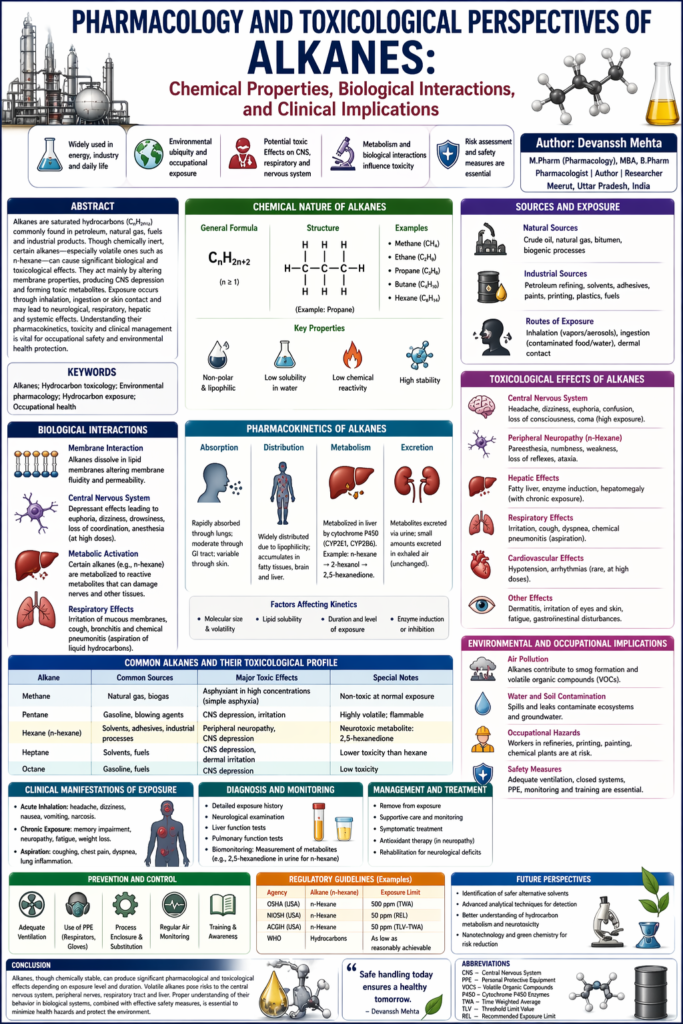
Alkanes are a class of saturated hydrocarbons characterized by single carbon–carbon bonds and the general molecular formula CₙH₂ₙ₊₂. These compounds are widely distributed in nature and are commonly found in petroleum, natural gas, and various industrial products. Although alkanes are primarily recognized for their importance in the energy sector and chemical industry, their interactions with biological systems have attracted increasing attention in the fields of toxicology, environmental health, and pharmacology.
From a pharmacological perspective, alkanes generally exhibit limited direct therapeutic activity; however, they can exert significant biological effects through mechanisms related to membrane interactions, metabolic transformations, and central nervous system depression. Exposure to certain alkanes, particularly volatile hydrocarbons such as hexane and pentane, may lead to toxicological effects involving neurological, respiratory, and hepatic systems. These compounds may act as anesthetic-like agents by altering membrane fluidity and interfering with neuronal signaling pathways.
In clinical toxicology, alkane exposure is often associated with occupational hazards, environmental contamination, and accidental inhalation of hydrocarbon vapors. Long-term exposure to specific alkanes may result in peripheral neuropathy, respiratory irritation, and central nervous system depression. Advances in analytical chemistry and environmental pharmacology have enhanced understanding of alkane metabolism, toxicokinetics, and mechanisms of toxicity.
This review article provides a comprehensive analysis of the pharmacology and toxicology of alkanes, focusing on their chemical characteristics, biological interactions, pharmacokinetics, toxicological effects, and clinical implications. The article also explores environmental and occupational health concerns associated with alkane exposure. Understanding the biological effects of alkanes is essential for improving risk assessment, occupational safety, and environmental health management.
Keywords
Alkanes; hydrocarbon toxicology; environmental pharmacology; hydrocarbon exposure; occupational health
Introduction
Hydrocarbons represent one of the most fundamental classes of organic compounds and play a crucial role in both industrial chemistry and environmental science. Among these compounds, alkanes constitute a large group of saturated hydrocarbons characterized by single covalent bonds between carbon atoms. Their chemical simplicity and stability make them essential components of petroleum products, fuels, and numerous industrial materials.
Alkanes are widely distributed in natural environments and are present in crude oil, natural gas, and various organic deposits formed through geological processes. These compounds are also produced through biological pathways in certain microorganisms and plants. Because of their abundance and chemical stability, alkanes have become indispensable in energy production, chemical manufacturing, and industrial applications.
The general molecular formula of alkanes is CₙH₂ₙ₊₂, reflecting their saturated hydrocarbon structure in which all carbon atoms are bonded by single covalent bonds. This structural configuration results in relatively low chemical reactivity compared with unsaturated hydrocarbons such as alkenes and alkynes. Despite their chemical stability, alkanes can undergo metabolic transformations within biological systems, leading to the formation of various metabolites that may exert biological effects.
In pharmacology and toxicology, the study of hydrocarbon interactions with biological systems has gained increasing importance due to the widespread use of petroleum-based products and the potential health risks associated with hydrocarbon exposure. While alkanes themselves are generally considered chemically inert, certain members of this group can produce significant biological effects when inhaled, ingested, or absorbed through the skin.
Volatile alkanes, particularly those with relatively low molecular weight, are commonly present in fuels, solvents, and industrial emissions. These compounds can readily vaporize and enter the atmosphere, creating potential exposure risks for workers and individuals in contaminated environments. Inhalation of alkane vapors may lead to central nervous system depression, respiratory irritation, and other toxicological effects.
From a pharmacological standpoint, the biological activity of alkanes is largely related to their physicochemical properties rather than specific receptor-mediated interactions. Many alkanes exhibit lipophilic characteristics that allow them to dissolve in biological membranes and lipid-rich tissues. This property enables them to interact with neuronal membranes and alter membrane fluidity, potentially affecting nerve conduction and neurotransmission.
The effects of hydrocarbons on the central nervous system have been recognized for many years. Certain hydrocarbons exhibit anesthetic-like properties by interfering with neuronal signaling pathways and modifying the physical properties of cell membranes. Although alkanes are not commonly used as therapeutic anesthetics, their effects on neuronal membranes provide insight into the mechanisms underlying hydrocarbon toxicity.
One of the most extensively studied alkanes in toxicology is n-hexane, a solvent widely used in industrial processes such as printing, textile manufacturing, and chemical production. Chronic exposure to n-hexane has been associated with peripheral neuropathy, a condition characterized by damage to peripheral nerves and resulting in symptoms such as numbness, weakness, and impaired motor coordination.
The neurotoxic effects of n-hexane are believed to result from its metabolic conversion to 2,5-hexanedione, a compound capable of interacting with neuronal proteins and disrupting axonal transport mechanisms. This example illustrates how metabolic transformations of hydrocarbons can generate biologically active metabolites that contribute to toxicological outcomes.
In addition to neurological effects, exposure to certain alkanes may also affect the respiratory and cardiovascular systems. Inhalation of hydrocarbon vapors can irritate the respiratory tract and may lead to pulmonary complications in cases of prolonged exposure. Furthermore, aspiration of liquid hydrocarbons can result in chemical pneumonitis, a potentially serious inflammatory condition affecting lung tissues.
Another important area of concern involves environmental contamination resulting from petroleum spills, industrial emissions, and fuel leakage. Alkanes released into the environment may accumulate in soil and water systems, potentially affecting ecosystems and human health. Environmental pharmacology therefore plays an important role in evaluating the biological effects of hydrocarbon pollutants.
The metabolism of alkanes within the human body primarily occurs in the liver through enzymatic reactions catalyzed by cytochrome P450 enzymes. These metabolic processes convert hydrocarbons into more polar compounds that can be eliminated through renal or biliary excretion. However, metabolic activation can sometimes generate reactive intermediates that contribute to toxicological effects.
Despite the potential health risks associated with hydrocarbon exposure, the pharmacological study of alkanes has also contributed to broader understanding of membrane biology, neurotoxicity, and environmental toxicology. Investigations into hydrocarbon interactions with biological systems have provided valuable insights into the mechanisms by which chemical compounds influence cellular function.
In recent years, advances in environmental monitoring, analytical chemistry, and toxicological research have improved the ability to detect hydrocarbon exposure and assess its potential health impacts. Regulatory agencies have established occupational exposure limits and safety guidelines to protect workers from harmful levels of hydrocarbon vapors.
Understanding the pharmacology and toxicology of alkanes is therefore essential for healthcare professionals, toxicologists, environmental scientists, and industrial safety specialists. Continued research in this field will contribute to improved risk assessment, environmental protection, and occupational health management.
The objective of this review article is to provide a comprehensive analysis of the pharmacological and toxicological aspects of alkanes, including their chemical properties, biological interactions, pharmacokinetics, toxicological effects, and clinical implications.
Chemical Characteristics of Alkanes
Alkanes are saturated hydrocarbons composed entirely of carbon and hydrogen atoms connected by single covalent bonds.
Key characteristics include:
• Chemical stability
• Low polarity
• Lipophilic nature
• Relatively low reactivity
These properties influence their interactions with biological systems.
Biological Interactions
Alkanes interact with biological systems primarily through physical interactions with lipid membranes rather than specific receptor binding.
Major biological interactions include:
• Alteration of membrane fluidity
• Central nervous system depression
• Metabolic transformation into reactive intermediates
Pharmacokinetics of Alkanes
Absorption
Alkanes may enter the body through inhalation, ingestion, or dermal exposure.
Distribution
Due to their lipophilic nature, alkanes accumulate in fatty tissues and lipid-rich organs.
Metabolism
Metabolized mainly in the liver through cytochrome P450-mediated oxidation.
Excretion
Metabolites are eliminated through urine and exhaled air.
Toxicological Effects
Common toxicological effects of alkane exposure include:
• Central nervous system depression
• Peripheral neuropathy (e.g., hexane exposure)
• Respiratory irritation
• Chemical pneumonitis
Environmental and Occupational Health Implications
Workers in industries such as petroleum refining, chemical manufacturing, and fuel handling may experience increased exposure to alkanes.
Safety measures include:
• Proper ventilation
• Personal protective equipment
• Monitoring of occupational exposure levels
Future Perspectives
Future research directions include:
• Improved environmental monitoring technologies
• Development of safer industrial solvents
• Advanced toxicological studies on hydrocarbon metabolism
Conclusion
Although alkanes are primarily recognized as industrial hydrocarbons rather than therapeutic agents, their interactions with biological systems have important implications for toxicology, environmental health, and occupational safety. Understanding the pharmacological and toxicological properties of these compounds is essential for assessing health risks and developing effective protective strategies against hydrocarbon exposure.
References
Klaassen, C.D., 2019. Casarett and Doull’s Toxicology: The Basic Science of Poisons. McGraw Hill.
Rang, H.P., Dale, M.M., Ritter, J.M. and Flower, R.J., 2016. Rang and Dale’s Pharmacology. Elsevier.
ATSDR, 2020. Toxicological Profile for Aliphatic Hydrocarbons. Agency for Toxic Substances and Disease Registry.
WHO, 2017. Environmental Health Criteria for Hydrocarbon Compounds. World Health Organization.