

Author: Devanssh Mehta
M.Pharm (Pharmacology), MBA, B.Pharm
Pharmacologist | Author | Researcher
Meerut, Uttar Pradesh, India
Abstract
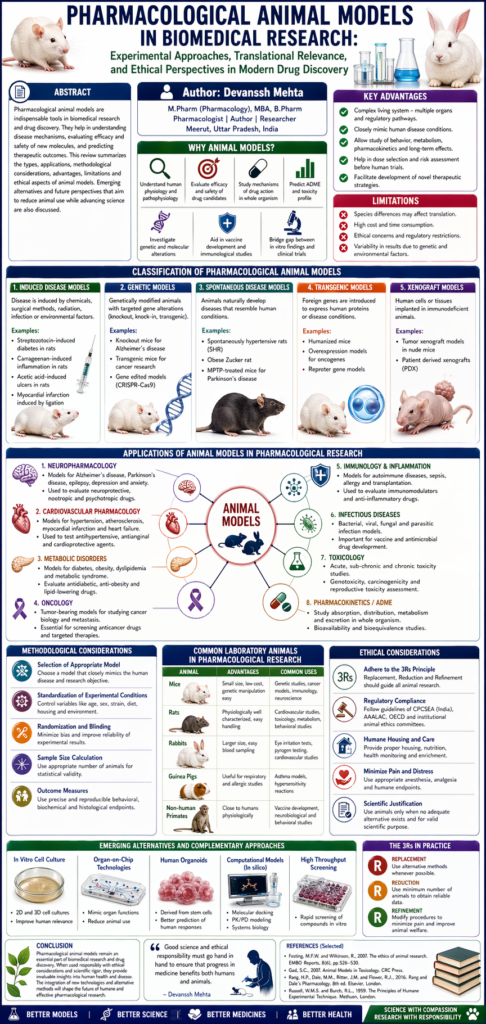
Pharmacological animal models play a critical role in the advancement of biomedical research and drug discovery. These experimental systems are designed to replicate human physiological and pathological conditions in laboratory animals, enabling researchers to investigate disease mechanisms, evaluate pharmacological effects of new compounds, and assess the safety and efficacy of therapeutic interventions. Over the past century, animal models have contributed significantly to the development of numerous life-saving drugs, vaccines, and medical technologies.
Animal models are widely used across various fields of pharmacology, including neuropharmacology, cardiovascular pharmacology, oncology, immunology, and metabolic disease research. Common laboratory animals used in pharmacological studies include rodents such as mice and rats, as well as rabbits, guinea pigs, and non-human primates. These models allow researchers to study complex biological processes in a controlled experimental environment.
The development of animal models involves careful consideration of biological relevance, reproducibility, and ethical responsibility. Experimental models may be classified into several categories, including disease-induced models, genetically modified models, and naturally occurring disease models. Each type offers distinct advantages for studying specific aspects of human disease.
Despite their valuable contributions to scientific progress, the use of animals in research has raised important ethical concerns. Regulatory frameworks and ethical guidelines have therefore been established to ensure humane treatment of laboratory animals and promote responsible research practices.
This review article provides a comprehensive overview of pharmacological animal models, focusing on their classification, experimental applications, methodological considerations, and ethical implications. The article also explores emerging alternatives such as organ-on-chip technologies and computational models that aim to complement or replace traditional animal testing in the future.
Keywords
Animal models; experimental pharmacology; biomedical research; drug discovery; laboratory animals
Introduction
The discovery and development of new therapeutic agents represent complex scientific processes that require a comprehensive understanding of biological systems, disease mechanisms, and pharmacological interactions. In modern biomedical research, experimental models serve as essential tools for investigating the physiological and pathological processes underlying human diseases. Among these experimental systems, pharmacological animal models have historically played a central role in advancing medical science and pharmaceutical innovation.
Animal models are experimental systems in which animals are used to simulate human diseases or physiological conditions. These models enable researchers to evaluate the pharmacodynamic and pharmacokinetic properties of new drugs, assess their safety profiles, and explore their mechanisms of action. By providing insights into biological responses that cannot be easily replicated in vitro, animal models remain indispensable in the early stages of drug development.
The concept of using animals for scientific research dates back to ancient civilizations. Early physicians and scholars conducted anatomical studies on animals to understand the structure and function of the human body. However, the systematic use of animal experimentation in pharmacology began to emerge during the nineteenth century with the development of modern experimental medicine.
Pioneering scientists such as Claude Bernard emphasized the importance of experimental physiology in understanding biological processes. Through controlled experiments on animals, researchers were able to investigate the effects of chemical substances on organ systems and develop foundational principles of pharmacology.
In contemporary biomedical research, animal models are used to study a wide range of diseases including cardiovascular disorders, neurological diseases, metabolic syndromes, infectious diseases, and cancer. These models provide valuable insights into disease pathogenesis and enable the testing of potential therapeutic interventions before clinical trials in humans.
One of the primary advantages of animal models is their ability to mimic complex biological interactions that occur within living organisms. Unlike cell culture systems or isolated biochemical assays, animal models allow researchers to observe systemic physiological responses involving multiple organs and regulatory mechanisms.
For example, cardiovascular disease models in animals enable scientists to study the interactions between the heart, blood vessels, endocrine system, and nervous system. Similarly, neuropharmacological models allow researchers to investigate behavioral responses, cognitive functions, and neurological disorders in living organisms.
Animal models are also essential for evaluating the safety and toxicity of new drugs. Before a pharmaceutical compound can be tested in human clinical trials, it must undergo rigorous preclinical testing to determine its potential adverse effects. Animal studies provide critical data on drug metabolism, organ toxicity, reproductive effects, and long-term safety.
Another important aspect of animal models in pharmacology is their role in understanding disease mechanisms. Many diseases involve complex molecular and cellular pathways that are difficult to study directly in humans. By inducing disease-like conditions in animals, researchers can investigate the biological processes involved in disease development and progression.
Over time, advances in biotechnology and genetic engineering have significantly expanded the capabilities of animal models. Genetically modified animals, including transgenic and knockout mice, allow scientists to study the effects of specific genes on physiological functions and disease susceptibility.
These genetically engineered models have become particularly valuable in fields such as cancer research, neurodegenerative disease studies, and immunology. By manipulating genetic pathways, researchers can create animal models that closely resemble human disease conditions.
Despite the scientific benefits of animal experimentation, the use of animals in research has been the subject of ongoing ethical debate. Concerns regarding animal welfare and humane treatment have led to the development of ethical guidelines and regulatory frameworks governing the use of animals in scientific research.
The principle of the 3Rs—Replacement, Reduction, and Refinement—has become a cornerstone of ethical animal research. Replacement refers to the use of alternative methods whenever possible, reduction involves minimizing the number of animals used in experiments, and refinement focuses on improving experimental procedures to minimize animal suffering.
In recent years, technological advances have led to the development of alternative research methods such as organ-on-chip systems, three-dimensional cell cultures, and computational modeling. These approaches aim to complement traditional animal models and reduce reliance on animal experimentation.
Nevertheless, animal models continue to play an essential role in pharmacological research, particularly in areas where complex physiological interactions must be studied within a living organism.
Understanding the strengths and limitations of animal models is therefore crucial for designing effective experimental studies and ensuring the reliability of scientific findings.
The objective of this review article is to provide a comprehensive analysis of pharmacological animal models, focusing on their classification, experimental applications, methodological considerations, and ethical implications in modern biomedical research.
Classification of Pharmacological Animal Models
Animal models can be broadly classified into several categories:
Induced Disease Models
Disease conditions are experimentally induced through chemical, surgical, or environmental interventions.
Examples include chemically induced diabetes models and inflammation models.
Genetic Models
Genetically modified animals are engineered to express or suppress specific genes.
These models are widely used in cancer and neurodegenerative disease research.
Spontaneous Disease Models
Certain animals naturally develop diseases that resemble human conditions.
Examples include hypertensive rat models.
Transgenic Models
Transgenic animals carry foreign genes inserted into their genome for experimental purposes.
Applications in Pharmacological Research
Animal models are widely used across various branches of pharmacology:
Neuropharmacology
Animal models are used to study neurological disorders such as Parkinson’s disease, Alzheimer’s disease, and epilepsy.
Cardiovascular Pharmacology
Models of hypertension, myocardial infarction, and atherosclerosis help evaluate cardiovascular drugs.
Metabolic Disease Models
Rodent models of diabetes and obesity are used to investigate antidiabetic therapies.
Cancer Research
Tumor-bearing animal models allow researchers to study anticancer drugs and tumor biology.
Methodological Considerations
Developing reliable animal models requires careful consideration of several factors:
• Biological relevance to human disease
• Reproducibility of experimental outcomes
• Appropriate experimental design
• Standardization of experimental conditions
Ethical Considerations
Ethical guidelines for animal experimentation emphasize humane treatment and responsible research practices.
Regulatory frameworks such as institutional animal ethics committees ensure compliance with ethical standards.
Emerging Alternatives
Technological innovations are providing alternatives to traditional animal models:
• Organ-on-chip systems
• Computational pharmacology models
• Three-dimensional cell culture models
These approaches aim to reduce animal usage while maintaining scientific accuracy.
Conclusion
Pharmacological animal models have played a vital role in advancing biomedical research and drug discovery. By enabling the study of complex physiological processes and disease mechanisms, these models have contributed significantly to the development of modern therapeutics. While ethical concerns and technological advancements are encouraging the exploration of alternative research methods, animal models remain an indispensable component of pharmacological research. Continued efforts to refine experimental methods and promote ethical practices will ensure that animal research contributes responsibly to scientific progress.
References
Festing, M.F.W. and Wilkinson, R., 2007. The ethics of animal research. EMBO Reports, 8(6), pp.526–530.
Gad, S.C., 2007. Animal Models in Toxicology. CRC Press.
Rang, H.P., Dale, M.M., Ritter, J.M. and Flower, R.J., 2016. Rang and Dale’s Pharmacology. London: Elsevier.
Russell, W.M.S. and Burch, R.L., 1959. The Principles of Humane Experimental Technique. London: Methuen.