

Author: Devanssh Mehta
M.Pharm (Pharmacology), MBA, B.Pharm
Pharmacologist | Author | Researcher
Meerut, Uttar Pradesh, India
Abstract
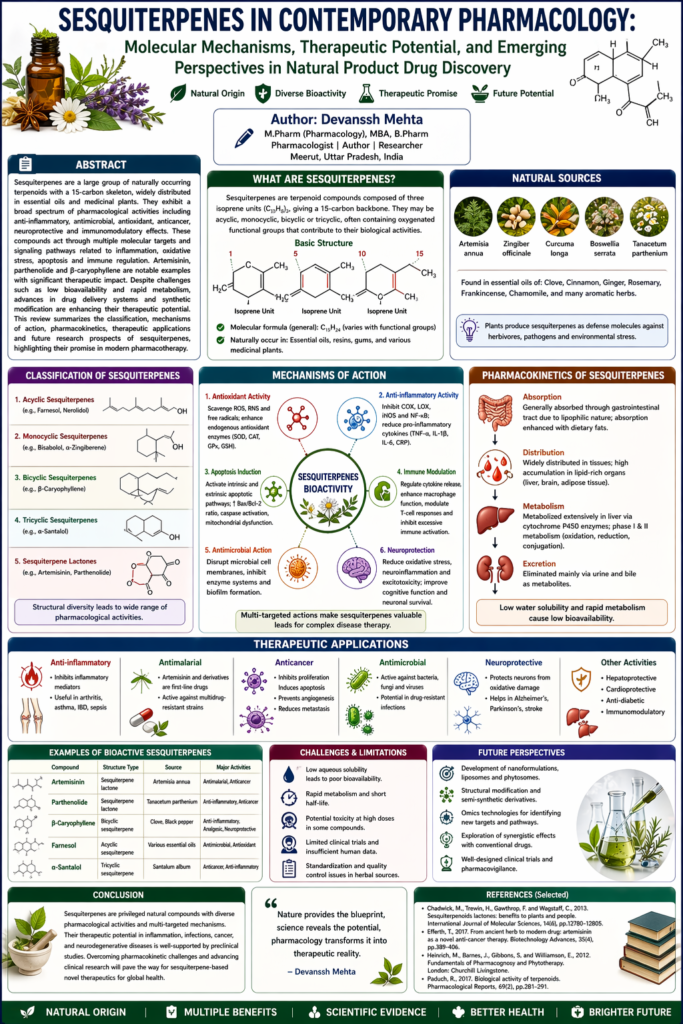
Sesquiterpenes represent an important class of naturally occurring terpenoid compounds widely distributed in essential oils, medicinal plants, and various botanical sources. Structurally characterized by a fifteen-carbon backbone derived from three isoprene units, sesquiterpenes exhibit remarkable chemical diversity and biological activity. Over the past few decades, these compounds have gained increasing attention in pharmacological research due to their diverse therapeutic properties, including anti-inflammatory, antimicrobial, antioxidant, anticancer, neuroprotective, and immunomodulatory activities.
The pharmacological significance of sesquiterpenes is largely attributed to their ability to interact with multiple cellular targets and signaling pathways involved in disease pathogenesis. Several sesquiterpenes, such as artemisinin, parthenolide, and β-caryophyllene, have demonstrated potent pharmacological effects that have led to the development of clinically important therapeutic agents. Artemisinin and its derivatives, for example, revolutionized the treatment of malaria and represent one of the most significant contributions of natural products to modern pharmacotherapy.
Mechanistically, sesquiterpenes exert their biological effects through modulation of oxidative stress, inhibition of inflammatory mediators, induction of apoptosis in cancer cells, and regulation of immune responses. Their lipophilic nature allows them to interact effectively with biological membranes and intracellular targets, contributing to their pharmacodynamic activity.
Despite their promising pharmacological potential, challenges related to bioavailability, pharmacokinetics, and clinical validation remain important considerations in the therapeutic development of sesquiterpene compounds. Advances in molecular pharmacology, nanotechnology-based drug delivery systems, and synthetic modification strategies are currently being explored to enhance the therapeutic efficacy of these compounds.
This review article provides a comprehensive analysis of the pharmacology of sesquiterpenes, focusing on their chemical classification, molecular mechanisms of action, pharmacokinetic characteristics, therapeutic applications, and future research directions. Understanding the pharmacological potential of sesquiterpenes may facilitate the discovery of novel drug candidates and contribute to the advancement of natural product-based pharmacotherapy.
Keywords
Sesquiterpenes; terpenoids; natural product pharmacology; phytochemicals; anti-inflammatory compounds
Introduction
Natural products have historically served as a cornerstone in the development of modern pharmacology. From the earliest herbal remedies used in traditional medicine to the sophisticated pharmaceutical agents employed in contemporary clinical practice, plant-derived compounds have played a crucial role in shaping the therapeutic landscape. Among the diverse categories of phytochemicals found in plants, terpenoids represent one of the largest and most structurally diverse classes of natural compounds.
Sesquiterpenes constitute an important subgroup of terpenoids characterized by their fifteen-carbon skeleton formed from three isoprene units. These compounds are widely distributed in nature and are commonly found in essential oils produced by aromatic plants. Many medicinal plants used in traditional medicine systems, including Ayurveda, Traditional Chinese Medicine, and indigenous herbal traditions, contain significant amounts of sesquiterpenes that contribute to their therapeutic properties.
From a chemical perspective, sesquiterpenes exhibit remarkable structural diversity. Their molecular structures may be linear, cyclic, or polycyclic, and they often contain functional groups such as alcohols, ketones, lactones, and epoxides. This structural diversity is responsible for the wide range of biological activities associated with sesquiterpene compounds.
In plants, sesquiterpenes play several important ecological and physiological roles. They function as defense molecules against herbivores and microbial pathogens, contribute to plant communication through volatile signaling compounds, and participate in plant growth regulation. These ecological functions highlight the evolutionary importance of sesquiterpenes in plant survival and adaptation.
The pharmacological significance of sesquiterpenes has attracted considerable scientific interest in recent decades. Advances in phytochemistry, molecular biology, and pharmacology have enabled researchers to isolate and characterize numerous sesquiterpene compounds with promising therapeutic properties.
One of the most notable examples of a pharmacologically important sesquiterpene is artemisinin, a sesquiterpene lactone isolated from the plant Artemisia annua. Artemisinin and its derivatives have revolutionized the treatment of malaria and remain a cornerstone of antimalarial therapy worldwide. The discovery of artemisinin demonstrates the immense potential of natural products in the development of life-saving medicines.
Beyond their antimalarial properties, sesquiterpenes exhibit a broad spectrum of pharmacological activities including anti-inflammatory, antimicrobial, antiviral, anticancer, and neuroprotective effects. These compounds often exert their therapeutic actions through modulation of key biochemical pathways involved in inflammation, oxidative stress, and cellular signaling.
Inflammation is a fundamental biological response that occurs in reaction to infection, injury, or immune activation. While acute inflammation is essential for host defense and tissue repair, chronic inflammation is associated with numerous pathological conditions including arthritis, cardiovascular disease, diabetes, and cancer. Several sesquiterpenes have demonstrated the ability to inhibit inflammatory mediators such as cytokines, prostaglandins, and nitric oxide, thereby reducing inflammatory responses.
Another important pharmacological property of sesquiterpenes is their antioxidant activity. Oxidative stress, resulting from excessive production of reactive oxygen species, plays a significant role in the pathogenesis of many chronic diseases. Sesquiterpenes can neutralize reactive oxygen species and enhance the activity of endogenous antioxidant enzymes, thereby protecting cells from oxidative damage.
Sesquiterpenes have also shown considerable promise in the field of oncology. Numerous studies have reported that certain sesquiterpene compounds possess anticancer properties by inducing apoptosis, inhibiting cell proliferation, and suppressing tumor metastasis. These effects are often mediated through modulation of signaling pathways involved in cell cycle regulation and programmed cell death.
In addition to their anticancer activity, sesquiterpenes have demonstrated antimicrobial properties against a wide range of bacterial, fungal, and viral pathogens. These antimicrobial effects are particularly relevant in the context of increasing antibiotic resistance, which has become a major global health concern.
The pharmacological potential of sesquiterpenes is further enhanced by their lipophilic nature, which facilitates interaction with biological membranes and intracellular targets. However, this property can also influence their pharmacokinetic behavior, including absorption, distribution, metabolism, and excretion.
Despite the promising therapeutic potential of sesquiterpenes, several challenges remain in translating these compounds into clinically approved drugs. Issues such as low aqueous solubility, limited bioavailability, and rapid metabolic degradation can affect their pharmacological effectiveness. To address these challenges, researchers are exploring novel drug delivery systems, structural modification techniques, and synthetic analog development.
The growing interest in sesquiterpene pharmacology reflects a broader trend in drug discovery toward exploring natural products as sources of new therapeutic agents. Modern analytical techniques, including high-performance liquid chromatography, mass spectrometry, and nuclear magnetic resonance spectroscopy, have significantly improved the ability to identify and characterize bioactive compounds from natural sources.
Given the increasing prevalence of chronic diseases worldwide and the need for safer and more effective therapeutic agents, natural compounds such as sesquiterpenes offer promising opportunities for pharmaceutical innovation.
Therefore, the objective of this review article is to provide a comprehensive analysis of the pharmacology of sesquiterpenes, focusing on their classification, molecular mechanisms of action, pharmacokinetics, therapeutic applications, and future research prospects.
Classification of Sesquiterpenes
Sesquiterpenes are broadly classified based on their structural characteristics:
• Acyclic sesquiterpenes
• Monocyclic sesquiterpenes
• Bicyclic sesquiterpenes
• Tricyclic sesquiterpenes
• Sesquiterpene lactones
Each class exhibits distinct pharmacological properties and biological activities.
Pharmacological Mechanisms of Sesquiterpenes
Sesquiterpenes exert their biological effects through several molecular mechanisms:
Antioxidant activity
Neutralization of reactive oxygen species and enhancement of cellular antioxidant defenses.
Anti-inflammatory activity
Inhibition of inflammatory enzymes such as cyclooxygenase and lipoxygenase.
Apoptosis induction
Activation of apoptotic pathways in cancer cells through modulation of mitochondrial signaling.
Immune regulation
Modulation of cytokine production and immune cell function.
Pharmacokinetics of Sesquiterpenes
The pharmacokinetic profile of sesquiterpenes involves:
Absorption
Typically absorbed through the gastrointestinal tract due to their lipophilic nature.
Distribution
Distributed widely in tissues, particularly lipid-rich compartments.
Metabolism
Metabolized primarily in the liver by cytochrome P450 enzymes.
Excretion
Eliminated through urine and bile.
Therapeutic Applications
Anti-inflammatory Activity
Sesquiterpenes such as parthenolide and β-caryophyllene demonstrate strong anti-inflammatory effects.
Antimalarial Activity
Artemisinin derivatives remain essential treatments for malaria.
Anticancer Activity
Several sesquiterpenes inhibit cancer cell proliferation and induce apoptosis.
Antimicrobial Activity
Sesquiterpenes show activity against bacteria, fungi, and viruses.
Neuroprotective Effects
Certain sesquiterpenes may protect neurons from oxidative stress and neuroinflammation.
Future Perspectives
Future research on sesquiterpenes will likely focus on:
• Structural modification for enhanced potency
• Nanotechnology-based drug delivery systems
• Clinical trials for therapeutic validation
• Exploration of new plant sources
Conclusion
Sesquiterpenes represent a diverse and pharmacologically significant class of natural compounds with broad therapeutic potential. Their ability to interact with multiple biological targets and signaling pathways makes them promising candidates for drug development. Continued research in phytochemistry, molecular pharmacology, and pharmaceutical technology may lead to the discovery of novel sesquiterpene-based therapeutics capable of addressing major global health challenges.
References
Chadwick, M., Trewin, H., Gawthrop, F. and Wagstaff, C., 2013. Sesquiterpenoids lactones: benefits to plants and people. International Journal of Molecular Sciences, 14(6), pp.12780–12805.
Efferth, T., 2017. From ancient herb to modern drug: artemisinin as a novel anti-cancer therapy. Biotechnology Advances, 35(4), pp.389–406.
Heinrich, M., Barnes, J., Gibbons, S. and Williamson, E., 2012. Fundamentals of Pharmacognosy and Phytotherapy. London: Churchill Livingstone.
Paduch, R., 2017. Biological activity of terpenoids. Pharmacological Reports, 69(2), pp.281–291.