

Author: Devanssh Mehta
M.Pharm (Pharmacology), MBA, B.Pharm
Pharmacologist | Author | Researcher
Meerut, Uttar Pradesh, India
Abstract
The legal framework of a nation represents the structural foundation upon which governance, justice, and social order are built. In India, the legal system is characterized by a complex and dynamic interaction of constitutional provisions, statutory laws, judicial precedents, administrative regulations, and international legal commitments. As the world’s largest democracy, India has developed a multifaceted legal framework that reflects its historical evolution, socio-political diversity, and commitment to constitutional governance.
The Indian legal system is primarily rooted in the Constitution of India, which serves as the supreme law of the land and provides the foundational principles governing legislative authority, executive power, and judicial independence. Over time, the legal framework has evolved through legislative reforms, judicial interpretations, and policy innovations designed to address the changing needs of society. Areas such as economic regulation, environmental protection, intellectual property rights, digital governance, and public health law have witnessed significant legal developments in recent decades.
This review article provides a comprehensive analysis of the legal framework in India, examining its constitutional foundations, institutional architecture, legislative processes, and regulatory mechanisms. The article also explores contemporary challenges facing the Indian legal system, including judicial backlog, regulatory complexity, technological transformation, and globalization of legal norms.
Furthermore, the review highlights emerging trends such as digital courts, alternative dispute resolution mechanisms, and the increasing role of constitutional jurisprudence in shaping governance outcomes. Understanding the structure and dynamics of India’s legal framework is essential for policymakers, scholars, and practitioners seeking to strengthen the rule of law and promote justice in an increasingly complex socio-economic environment.
Keywords
Indian legal system; constitutional law; rule of law; judicial system; regulatory governance
Introduction
The legal framework of a nation forms the backbone of its governance structure, providing mechanisms for regulating social interactions, resolving disputes, and protecting the rights of citizens. In modern democratic societies, the rule of law serves as the guiding principle that ensures equality before the law, accountability of institutions, and protection of fundamental rights. India, as the world’s largest democracy, possesses one of the most elaborate and sophisticated legal systems in the world.
India’s legal framework is deeply rooted in its historical evolution, reflecting influences from ancient traditions, colonial legal systems, and post-independence constitutional developments. The contemporary Indian legal system represents a synthesis of common law traditions inherited from the British colonial period and indigenous constitutional principles established after independence in 1947.
The cornerstone of the Indian legal framework is the Constitution of India, which came into force on 26 January 1950. The Constitution provides the foundational legal architecture for governance in India, defining the structure of government institutions, the distribution of powers between the Union and the states, and the fundamental rights guaranteed to citizens. As the supreme law of the land, the Constitution establishes the principles of justice, liberty, equality, and fraternity that guide the functioning of the Indian state.
One of the most distinctive features of the Indian legal system is its commitment to constitutional supremacy and judicial review. The judiciary, particularly the Supreme Court of India, possesses the authority to interpret the Constitution and invalidate laws that violate constitutional provisions. This power ensures that legislative and executive actions remain consistent with constitutional principles.
India’s legal framework operates through a multi-layered institutional structure consisting of legislative bodies, executive authorities, and judicial institutions. The Parliament of India is responsible for enacting laws that regulate various aspects of social and economic life, while state legislatures perform similar functions at the regional level. Administrative agencies and regulatory authorities implement these laws and oversee compliance with regulatory standards.
In addition to statutory laws enacted by legislatures, the Indian legal system also relies heavily on judicial precedents. Courts interpret statutes and constitutional provisions, creating legal doctrines that guide future decisions. This system of precedent, derived from the common law tradition, ensures consistency and predictability in legal interpretation.
Over the past several decades, India’s legal framework has expanded significantly in response to new societal challenges. Areas such as environmental protection, consumer rights, digital privacy, intellectual property, and corporate governance have witnessed the introduction of specialized legislation and regulatory institutions.
For example, the enactment of the Environment Protection Act (1986) and subsequent environmental laws has strengthened regulatory oversight of industrial activities and natural resource management. Similarly, the Information Technology Act (2000) established legal mechanisms for addressing cybercrime and digital commerce.
The rapid growth of India’s economy and technological capabilities has also created new regulatory challenges. Digital platforms, artificial intelligence, data protection, and biotechnology require legal frameworks capable of addressing emerging risks while promoting innovation.
Another important dimension of India’s legal framework is its emphasis on fundamental rights and social justice. The Constitution guarantees a range of fundamental rights including the right to equality, freedom of speech, protection against discrimination, and the right to life and personal liberty. These rights form the basis for judicial interventions aimed at protecting marginalized communities and promoting inclusive development.
Despite these achievements, India’s legal system faces several structural challenges. Judicial delays, case backlogs, regulatory complexity, and limited access to justice remain significant concerns. According to various reports, millions of cases remain pending in Indian courts, highlighting the need for institutional reforms and modernization.
In response to these challenges, policymakers and legal scholars have proposed various reforms aimed at improving the efficiency and accessibility of the legal system. Initiatives such as digital courts, e-governance in the judiciary, and alternative dispute resolution mechanisms have been introduced to streamline legal processes and reduce case backlogs.
Globalization has also influenced the evolution of India’s legal framework. International trade agreements, human rights conventions, and cross-border regulatory standards increasingly shape domestic legal policies. As India continues to integrate into the global economy, its legal framework must adapt to international legal norms while preserving national sovereignty.
From a strategic perspective, a robust legal framework is essential for ensuring political stability, economic development, and protection of civil liberties. Effective legal systems promote investor confidence, facilitate business transactions, and uphold democratic accountability.
Therefore, the objective of this review article is to examine the structure, evolution, and future trajectory of India’s legal framework. By analyzing constitutional foundations, institutional mechanisms, and emerging legal challenges, this article seeks to provide a comprehensive understanding of the legal architecture that underpins governance in India.
Constitutional Foundations of the Indian Legal System
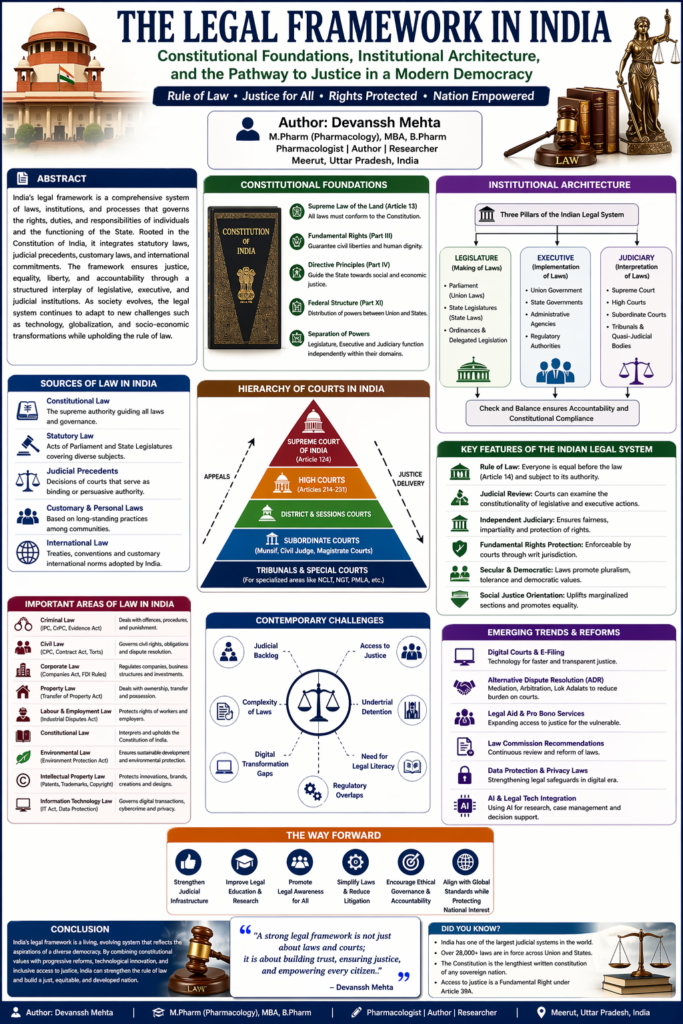
The Constitution of India forms the cornerstone of the country’s legal framework. It establishes:
• Fundamental rights
• Directive principles of state policy
• Federal structure of governance
• Separation of powers among branches of government
Institutional Structure of the Legal System
India’s legal system operates through three primary institutions:
Legislature
Responsible for making laws at the national and state levels.
Executive
Implements and enforces laws through administrative agencies.
Judiciary
Interprets laws and ensures constitutional compliance.
Sources of Law in India
The Indian legal system derives authority from several sources:
• Constitutional provisions
• Statutory legislation
• Judicial precedents
• Customary laws
• International treaties
Emerging Legal Areas
Modern legal frameworks in India increasingly address areas such as:
• Digital privacy and data protection
• Environmental regulation
• Intellectual property rights
• Cybersecurity laws
Challenges in the Legal System
Major challenges include:
• Judicial backlog
• Limited access to justice
• Regulatory complexity
• Need for modernization
Future Directions
Future reforms may include:
• Expansion of digital courts
• Strengthening alternative dispute resolution
• Legal technology integration
Conclusion
India’s legal framework represents a dynamic system rooted in constitutional principles and shaped by evolving social and economic realities. Strengthening institutional capacity, improving access to justice, and adapting to emerging technological challenges will be essential for ensuring the continued effectiveness of the Indian legal system in the decades ahead.
References (Harvard Style)
Austin, G., 2000. The Indian Constitution: Cornerstone of a Nation. Oxford University Press.
Seervai, H.M., 1996. Constitutional Law of India. Bombay: N.M. Tripathi.
Government of India, 1950. The Constitution of India. New Delhi: Government of India.
Sathe, S.P., 2002. Judicial Activism in India. Oxford University Press.