

Author: Devanssh Mehta
M.Pharm (Pharmacology), MBA, B.Pharm
Pharmacologist | Author | Researcher
Meerut, Uttar Pradesh, India
Abstract
Patent law represents one of the most critical pillars of intellectual property governance in modern knowledge-based economies. In India, the evolution of patent law has been shaped by a complex interaction of domestic policy priorities, international trade agreements, technological advancements, and public welfare considerations. Since the implementation of the Indian Patents Act amendments in 2005, which aligned the national intellectual property framework with the provisions of the World Trade Organization’s Agreement on Trade-Related Aspects of Intellectual Property Rights (TRIPS), India has emerged as an important player in global innovation ecosystems. However, the rapidly evolving landscape of biotechnology, artificial intelligence, pharmaceuticals, and digital technologies is creating new challenges and opportunities for patent regulation in the country.
The future of patent laws in India will likely be influenced by multiple factors including technological disruption, globalization of innovation, access to medicines, digital transformation, and the growth of indigenous research and development capabilities. Policymakers must balance the competing objectives of promoting innovation, protecting intellectual property rights, ensuring fair competition, and safeguarding public interest.
This review article provides a comprehensive analysis of the evolution of patent laws in India, examining the legal framework, institutional mechanisms, and emerging challenges associated with intellectual property governance. The article further explores the strategic implications of patent policy for sectors such as pharmaceuticals, biotechnology, information technology, and artificial intelligence. In addition, it highlights the role of patent reforms in supporting India’s ambition to become a global innovation leader.
Understanding the future trajectory of patent laws in India is essential for policymakers, researchers, industry leaders, and legal scholars seeking to navigate the complex intersection of technology, law, and economic development in the twenty-first century.
Keywords
Patent law; intellectual property; innovation policy; pharmaceutical patents; India
Introduction
The protection of intellectual property has long been recognized as a fundamental component of technological progress and economic development. Patent systems provide legal mechanisms that grant inventors exclusive rights over their innovations for a limited period, thereby incentivizing research and development while enabling knowledge dissemination after patent expiration. In modern economies driven by technological innovation, patent law plays a central role in shaping industrial competitiveness, scientific advancement, and economic growth.
India’s journey in patent law reflects the evolving priorities of a developing nation seeking to balance innovation incentives with public welfare. During the early decades following independence, India adopted a relatively restrictive patent regime designed to promote domestic industrial development and ensure access to essential goods, particularly medicines. The Indian Patents Act of 1970 introduced significant reforms that limited product patents in pharmaceuticals and food products, allowing only process patents for these sectors. This approach enabled the growth of India’s generic pharmaceutical industry and significantly improved access to affordable medicines.
However, the globalization of trade and the establishment of the World Trade Organization in 1995 introduced new international obligations for intellectual property protection. The Agreement on Trade-Related Aspects of Intellectual Property Rights (TRIPS) required member countries to adopt minimum standards for patent protection across all technological fields. As a result, India implemented a series of legislative amendments culminating in the Patents (Amendment) Act of 2005, which introduced product patents in pharmaceuticals and biotechnology.
These reforms marked a turning point in India’s intellectual property landscape. While the introduction of product patents strengthened innovation incentives and aligned India with global patent systems, it also raised concerns about access to medicines, particularly in the context of life-saving drugs. The Indian patent system therefore incorporated safeguards such as Section 3(d), which prevents the patenting of minor modifications of known substances unless they demonstrate significant therapeutic efficacy. This provision has played a crucial role in preventing “evergreening” of pharmaceutical patents.
In the contemporary era, the dynamics of patent law are increasingly influenced by rapid technological transformation. Emerging fields such as artificial intelligence, gene editing, nanotechnology, and digital innovation are challenging traditional patent frameworks. These technologies often involve complex, interdisciplinary inventions that may not fit neatly within existing intellectual property categories.
The Indian government has recognized the importance of intellectual property in fostering innovation and economic development. Initiatives such as the National Intellectual Property Rights Policy (2016) aim to strengthen India’s IP ecosystem by improving patent examination capacity, promoting innovation awareness, and encouraging research and development activities.
At the same time, India faces the challenge of balancing innovation incentives with public interest considerations. The pharmaceutical sector provides a particularly important example of this balancing act. India is often referred to as the “pharmacy of the developing world” due to its large-scale production of affordable generic medicines. Maintaining this role while complying with international patent obligations requires careful policy design.
Another emerging dimension of patent law relates to the increasing globalization of research and development activities. Multinational corporations, academic institutions, and collaborative research networks are playing a growing role in innovation ecosystems. Patent systems must therefore adapt to cross-border intellectual property disputes and international technology transfer agreements.
Digital technologies are also reshaping the patent landscape. Artificial intelligence-driven inventions raise important legal questions regarding inventorship, patent eligibility, and ownership of machine-generated innovations. These developments are prompting policymakers worldwide to reconsider traditional patent doctrines.
Furthermore, the expansion of biotechnology and genetic engineering presents new regulatory challenges. Patent claims involving biological materials, gene sequences, and genetically modified organisms require careful evaluation to ensure ethical and legal compliance.
In the context of India’s ambition to become a global innovation hub, the future of patent law will be closely linked to national research and development strategies. Investments in science, technology, engineering, and innovation will require strong intellectual property frameworks capable of protecting novel inventions while promoting knowledge dissemination.
Therefore, the objective of this review article is to examine the evolving landscape of patent laws in India and analyze the strategic implications of future reforms. The article explores the legal framework governing patents, emerging technological challenges, and policy considerations shaping the future of intellectual property governance in India.
Evolution of Patent Laws in India
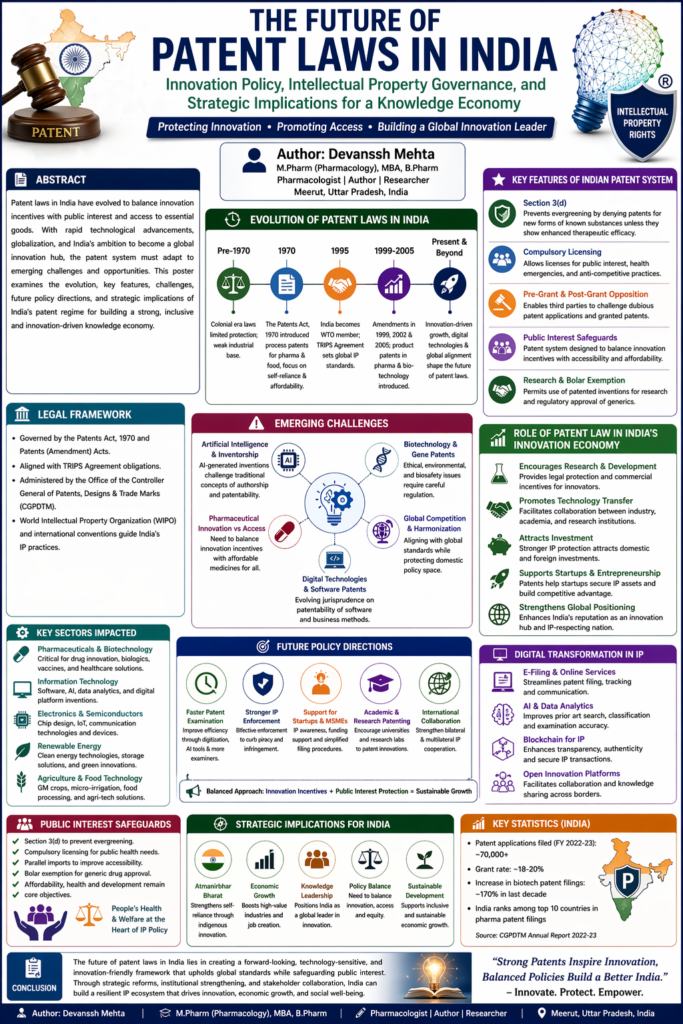
India’s patent system has evolved through several important legislative phases:
The Patents Act, 1970
This act established a patent regime designed to encourage domestic manufacturing and prevent monopolistic practices. It limited product patents in pharmaceuticals and food products.
TRIPS Compliance and Amendments
Between 1999 and 2005, India implemented several amendments to comply with TRIPS requirements, including the introduction of product patents in pharmaceuticals.
Key Features of the Indian Patent System
The Indian patent system includes several distinctive provisions:
• Section 3(d) preventing evergreening
• Compulsory licensing provisions
• Patent opposition mechanisms
• Strong public interest safeguards
Emerging Challenges in Patent Law
Several technological and legal developments are shaping the future of patent law:
Artificial Intelligence and Patentability
AI-generated inventions challenge traditional definitions of inventorship.
Biotechnology and Gene Patents
Advances in genomics and gene editing technologies raise ethical and legal questions.
Pharmaceutical Innovation
Balancing innovation incentives with affordable medicine access remains a key policy challenge.
Role of Patent Law in India’s Innovation Economy
A strong patent system can:
• Encourage research and development
• Promote technology transfer
• Attract foreign investment
• Strengthen domestic innovation ecosystems
Future Policy Directions
Future reforms may include:
• Faster patent examination processes
• Strengthening IP enforcement mechanisms
• Supporting startup innovation
• Encouraging academic patenting
Strategic Implications for India
India’s patent policy will play a critical role in shaping the country’s technological competitiveness and economic growth in the coming decades.
Conclusion
The future of patent laws in India will be shaped by the interplay between technological innovation, international trade obligations, and public welfare considerations. By maintaining a balanced intellectual property framework that supports both innovation and accessibility, India can strengthen its position as a global leader in science, technology, and pharmaceutical manufacturing.
References (Harvard Style)
Basant, R., 2012. Intellectual property rights regime in India. Economic and Political Weekly, 47(19), pp.45–52.
Correa, C., 2013. Intellectual Property Rights and Access to Medicines. Geneva: WHO.
Government of India, 2016. National Intellectual Property Rights Policy. New Delhi: Department for Promotion of Industry and Internal Trade.
WTO, 1995. Agreement on Trade-Related Aspects of Intellectual Property Rights (TRIPS). Geneva: World Trade Organization.