

Author: Devanssh Mehta
M.Pharm (Pharmacology), MBA, B.Pharm
Pharmacologist | Author | Researcher
Meerut, Uttar Pradesh, India
Abstract
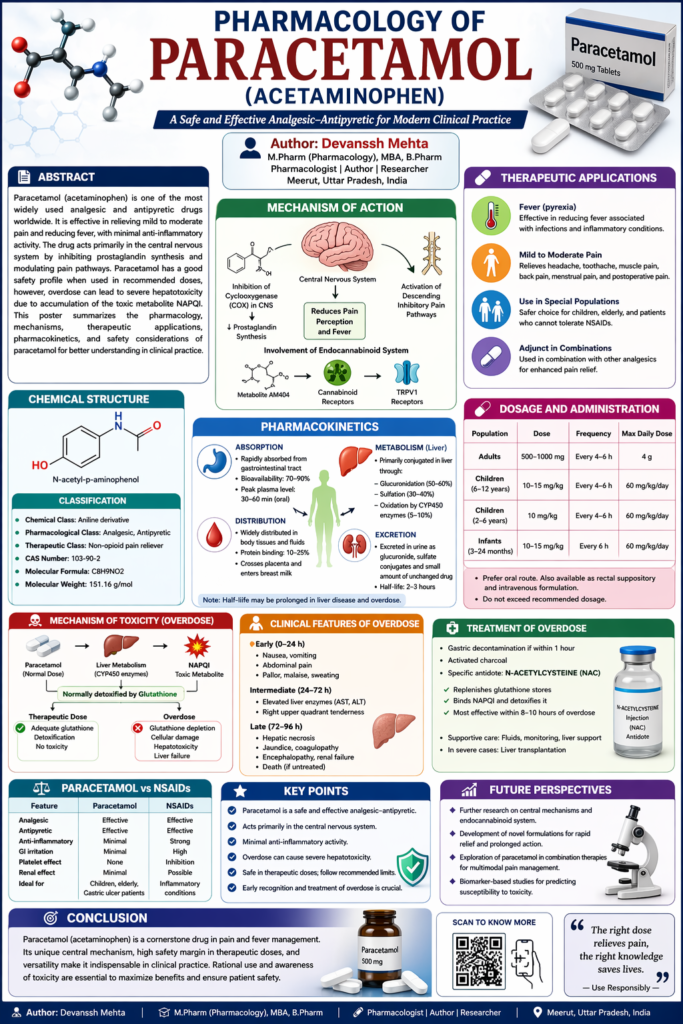
Paracetamol, also known as acetaminophen, is one of the most widely used analgesic and antipyretic medications worldwide. Despite its long history of clinical use and widespread availability as an over-the-counter drug, the pharmacological mechanisms underlying its therapeutic effects remain complex and continue to be explored. Unlike traditional nonsteroidal anti-inflammatory drugs (NSAIDs), paracetamol exhibits minimal anti-inflammatory activity while demonstrating effective analgesic and antipyretic properties. This unique pharmacological profile has made paracetamol a first-line therapeutic agent for the management of mild to moderate pain and fever across diverse patient populations, including pediatric and geriatric groups.
The pharmacological activity of paracetamol is primarily mediated through central nervous system mechanisms involving inhibition of prostaglandin synthesis and modulation of serotonergic pathways. Emerging research also suggests the involvement of the endocannabinoid system and the formation of active metabolites such as N-arachidonoylphenolamine (AM404), which contributes to its analgesic activity. In addition to its therapeutic benefits, paracetamol possesses a well-established safety profile when administered within recommended dosage limits. However, excessive consumption can lead to severe hepatotoxicity due to the formation of the reactive metabolite N-acetyl-p-benzoquinone imine (NAPQI).
This review article provides a comprehensive overview of the pharmacology of paracetamol, including its chemical structure, pharmacodynamics, pharmacokinetics, therapeutic applications, mechanisms of toxicity, and clinical considerations. Furthermore, the article explores emerging perspectives regarding the molecular mechanisms of paracetamol action and its evolving role in modern clinical pharmacology. Understanding the pharmacological profile of paracetamol is essential for optimizing therapeutic use while minimizing potential adverse effects.
Keywords
Paracetamol; acetaminophen; analgesic pharmacology; hepatotoxicity; prostaglandin inhibition
Introduction
Pain and fever represent two of the most common clinical symptoms encountered in medical practice. Effective management of these conditions is essential for improving patient comfort, enhancing quality of life, and preventing complications associated with prolonged inflammation or infection. Among the various pharmacological agents available for the treatment of pain and fever, paracetamol occupies a unique and widely respected position in modern medicine.
Paracetamol, chemically known as N-acetyl-p-aminophenol, was first synthesized in the late nineteenth century and introduced into clinical practice during the mid-twentieth century. Since then, it has become one of the most commonly used medications globally due to its effectiveness, affordability, and relatively favorable safety profile. Unlike many analgesic drugs that require prescription authorization, paracetamol is widely available as an over-the-counter medication in numerous formulations including tablets, capsules, syrups, suppositories, and intravenous preparations.
From a pharmacological perspective, paracetamol is classified as an analgesic and antipyretic agent. It is particularly effective in managing mild to moderate pain associated with conditions such as headache, musculoskeletal disorders, postoperative pain, and dental pain. Additionally, paracetamol is widely used to reduce fever in infectious diseases and inflammatory conditions.
One of the defining characteristics of paracetamol is its distinct pharmacological profile compared with traditional nonsteroidal anti-inflammatory drugs (NSAIDs). While NSAIDs such as ibuprofen and aspirin exert their effects through peripheral inhibition of cyclooxygenase enzymes involved in prostaglandin synthesis, paracetamol primarily acts within the central nervous system. This difference explains why paracetamol produces minimal anti-inflammatory effects while retaining potent analgesic and antipyretic properties.
The precise mechanism of action of paracetamol has long been the subject of scientific investigation. Early studies suggested that paracetamol exerts its effects through inhibition of prostaglandin synthesis in the brain, thereby reducing pain perception and regulating body temperature. However, subsequent research has revealed that the pharmacological mechanisms of paracetamol are far more complex and involve multiple biochemical pathways.
Recent studies have highlighted the role of the endocannabinoid system in mediating the analgesic effects of paracetamol. After administration, paracetamol undergoes metabolic conversion to an active metabolite known as AM404, which interacts with cannabinoid receptors and transient receptor potential vanilloid (TRPV1) channels in the central nervous system. These interactions contribute to modulation of pain signaling pathways.
Another important pharmacological property of paracetamol is its ability to influence serotonergic pathways involved in pain modulation. By enhancing serotonergic neurotransmission within descending inhibitory pain pathways, paracetamol contributes to the suppression of nociceptive signals.
In addition to its therapeutic benefits, paracetamol is widely regarded as one of the safest analgesic medications when used at recommended doses. Unlike NSAIDs, it does not significantly affect platelet function or cause gastrointestinal irritation, making it particularly suitable for patients who are unable to tolerate NSAIDs.
However, the safety of paracetamol is dose-dependent. Excessive consumption of paracetamol can lead to severe liver toxicity, which represents one of the most common causes of acute liver failure worldwide. This toxicity is primarily mediated by the formation of a highly reactive metabolite known as NAPQI, which can damage liver cells if detoxification mechanisms become overwhelmed.
Understanding the pharmacology of paracetamol is therefore essential not only for optimizing therapeutic efficacy but also for preventing adverse drug reactions associated with overdose.
In the context of modern pharmacology, paracetamol remains an essential component of pain management strategies. Its widespread use across diverse clinical settings—from outpatient care to hospital medicine—highlights its enduring relevance in healthcare systems worldwide.
The objective of the present review is to provide a comprehensive overview of the pharmacological properties of paracetamol, including its mechanisms of action, pharmacokinetics, therapeutic applications, toxicity mechanisms, and emerging research developments. By synthesizing current scientific knowledge, this article aims to contribute to a deeper understanding of paracetamol and its continued significance in contemporary clinical medicine.
Chemical Structure and Classification
Paracetamol belongs to the class of aniline derivatives and is chemically designated as N-acetyl-p-aminophenol. Its molecular formula is C₈H₉NO₂, and it possesses a phenolic structure that contributes to its pharmacological activity.
The drug is classified pharmacologically as:
• Analgesic
• Antipyretic
• Non-opioid pain reliever
Pharmacodynamics of Paracetamol
The pharmacodynamic effects of paracetamol are primarily related to its ability to modulate prostaglandin synthesis and influence central nervous system pathways.
Prostaglandin Inhibition
Paracetamol inhibits cyclooxygenase enzymes within the central nervous system, reducing the synthesis of prostaglandins involved in pain and fever generation.
Central Analgesic Mechanism
The drug acts on central pain pathways to decrease the perception of pain.
Endocannabinoid Pathway
The metabolite AM404 interacts with cannabinoid receptors and TRPV1 receptors involved in pain modulation.
Pharmacokinetics
Paracetamol exhibits rapid absorption and distribution in the body.
Absorption
It is rapidly absorbed from the gastrointestinal tract following oral administration.
Distribution
The drug is widely distributed throughout body tissues and fluids.
Metabolism
Paracetamol is metabolized primarily in the liver through glucuronidation and sulfation pathways.
Excretion
Metabolites are excreted via the kidneys.
Therapeutic Applications
Paracetamol is widely used for the treatment of:
• Fever
• Headache
• Musculoskeletal pain
• Postoperative pain
• Osteoarthritis
Toxicity and Hepatotoxicity
Paracetamol overdose can lead to severe liver injury due to the accumulation of the toxic metabolite NAPQI.
Under normal conditions, NAPQI is detoxified by glutathione. However, in overdose situations, glutathione stores become depleted, leading to liver cell damage.
Safety and Clinical Considerations
Recommended maximum daily dosage for adults is generally 4 grams, though many guidelines recommend lower limits to reduce risk of toxicity.
Future Perspectives
Emerging research areas include:
• Novel paracetamol formulations
• Combination analgesic therapies
• Molecular studies on AM404 pathways
Conclusion
Paracetamol remains one of the most widely used analgesic and antipyretic drugs worldwide. Its effectiveness, safety profile, and accessibility have established it as a cornerstone of pain management in modern medicine. Continued research into its molecular mechanisms and clinical applications will further enhance its therapeutic potential.
References (Harvard Style)
Graham, G.G. and Scott, K.F., 2005. Mechanism of action of paracetamol. American Journal of Therapeutics, 12(1), pp.46–55.
Prescott, L.F., 2000. Paracetamol: past, present and future. American Journal of Therapeutics, 7(2), pp.143–147.
Toussaint, K., Yang, X., Zielinski, M.A., Reigle, K.L., Sacavage, S.D., Nagar, S. and Raffa, R.B., 2010. What do we know about paracetamol’s mechanism of action? Journal of Clinical Pharmacy and Therapeutics, 35(6), pp.617–638.
World Health Organization, 2021. WHO Model List of Essential Medicines. Geneva: WHO.