

A Simple and Deep Narrative on How the Human Heart Works
There is an organ inside the human body that begins its work even before a mother knows she is carrying life. Around the third week of development in the womb, a tiny cluster of cells starts beating. That beat does not stop for decades. It continues when we sleep, when we cry, when we laugh, when we work, and even when we forget it exists. This organ is the heart. It does not demand attention, yet it holds authority over life itself. To understand how the heart works is to understand how life is sustained every second.
The heart is not very large. It is roughly the size of a closed fist and rests slightly toward the left side of the chest, protected by the rib cage. Though small in size, it carries an enormous responsibility. Its main function is simple in words but extraordinary in action: it pumps blood throughout the body. Blood carries oxygen, nutrients, hormones, and other essential substances to every cell. At the same time, it carries waste products away from tissues so they can be removed. Without this constant movement of blood, organs would fail within minutes.
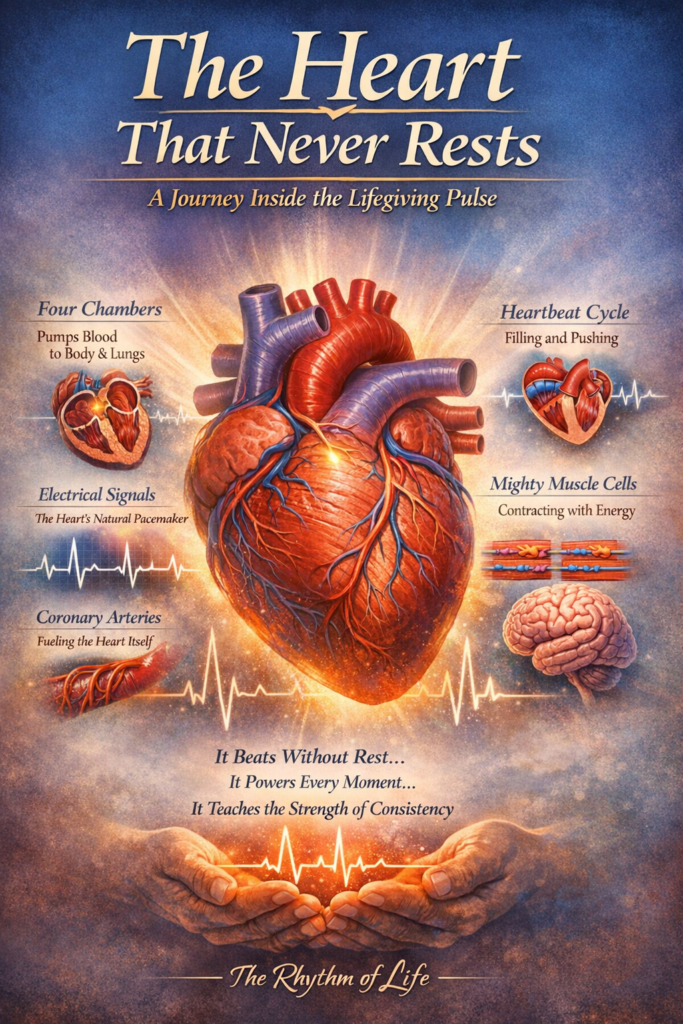
The heart is built like a carefully designed house with four rooms. These rooms are called chambers. The two upper chambers are known as the atria, and the two lower chambers are called the ventricles. The right side of the heart handles blood that has already delivered oxygen to the body and now needs fresh oxygen. This oxygen-poor blood enters the right atrium, then moves into the right ventricle. From there, it is pumped to the lungs. In the lungs, carbon dioxide is removed and oxygen is added. This fresh, oxygen-rich blood then returns to the left side of the heart. It enters the left atrium, moves into the left ventricle, and from there it is pumped forcefully to the entire body. This journey happens continuously, beat after beat, day after day.
Between these chambers are small but powerful structures called valves. Valves act like one-way doors. They make sure that blood flows forward and never backward. If these valves did not function properly, blood would leak in the wrong direction, and circulation would become weak and inefficient. The opening and closing of these valves create the familiar “lub-dub” sound we hear through a stethoscope. The first sound comes when the upper valves close, and the second sound comes when the lower valves close. These sounds are simple, but they tell doctors a great deal about the health of the heart.
What makes the heart truly remarkable is that it does not wait for instructions from the brain to beat. It has its own electrical system. In the upper part of the right atrium, there is a special group of cells known as the natural pacemaker. These cells automatically produce tiny electrical signals. Each signal spreads through the heart muscle and tells it when to contract. This electrical signal first causes the atria to contract and push blood into the ventricles. A fraction of a second later, the signal moves downward and causes the ventricles to contract. This careful timing ensures that blood flows smoothly and efficiently.
Every heartbeat follows a cycle. First, the heart relaxes and fills with blood. Then it contracts and pushes blood out. This sequence of filling and pumping is known as the cardiac cycle. In a healthy adult at rest, the heart beats about 60 to 100 times per minute. On average, it pumps about five liters of blood every minute. During exercise, when the body needs more oxygen, the heart can increase both its rate and the amount of blood pumped with each beat. In this way, the heart adjusts itself to meet the demands of the body. It works harder when needed and slows down when the body rests.
At a deeper level, each heartbeat is powered by tiny muscle cells called cardiomyocytes. These cells are arranged in a special pattern that allows them to contract together as one unit. Inside these cells are even smaller structures that slide against each other during contraction. This sliding action shortens the muscle and creates force. For this to happen, the cells need energy in the form of a molecule called ATP. They also need calcium, an important mineral that triggers contraction. When calcium enters the cells, contraction begins. When calcium is removed, the muscle relaxes. This careful balance between contraction and relaxation happens thousands of times every day without us noticing.
The heart is also supported by its own blood supply. Even though it pumps blood to the entire body, it needs its own arteries to receive oxygen and nutrients. These arteries are called coronary arteries. If they become blocked due to fat deposits or clots, part of the heart muscle may not receive enough oxygen. This condition can lead to chest pain or even a heart attack. When heart muscle cells die due to lack of oxygen, they cannot regenerate easily. That is why protecting the coronary arteries through healthy lifestyle choices is so important.
The heart does not work alone. It is influenced by the nervous system and by hormones. When we feel fear, excitement, or stress, our body releases substances like adrenaline. These chemicals increase heart rate and make the heart pump more strongly. This prepares the body for action. On the other hand, when we are calm and relaxed, another part of the nervous system slows the heart down. This balance allows the heart to respond to emotional and physical needs. It is fascinating that our thoughts and feelings can influence our heartbeat. A sudden shock can make the heart race. Deep breathing and meditation can slow it. In this way, the heart and mind are closely connected.
As we grow older, the heart changes gradually. The walls may become slightly thicker or stiffer. Blood vessels may lose some flexibility. However, with proper care, the heart can function effectively for many decades. Regular physical activity strengthens the heart muscle. A balanced diet prevents damage to blood vessels. Avoiding smoking protects the coronary arteries. Managing stress helps maintain a healthy rhythm. The heart rewards discipline and punishes neglect.
The heart is also incredibly adaptable. In athletes, the heart becomes stronger and slightly larger in a healthy way. It pumps more blood with each beat, allowing better endurance. However, in conditions like high blood pressure, the heart may enlarge in an unhealthy manner, making it harder to pump efficiently over time. Thus, the same organ can adapt positively or negatively depending on circumstances.
One of the most powerful aspects of the heart is its consistency. It does not take holidays. It does not demand rest. It beats approximately 100,000 times per day and over 35 million times per year. Over an average lifetime, it may beat more than two billion times. With each beat, it sustains life. It sends oxygen to the brain so we can think, to the muscles so we can move, to the kidneys so they can filter, and to every tiny cell so it can perform its function.
When doctors listen to the heart, measure blood pressure, or record an electrocardiogram, they are essentially studying rhythm and flow. A normal rhythm suggests balance. An irregular rhythm may indicate a disturbance in the electrical system. Weak pumping may suggest muscle damage. Each variation tells a story. The heart communicates through patterns rather than words.
Despite its strength, the heart is also sensitive. Severe emotional stress can temporarily weaken it. Lack of sleep can strain it. Uncontrolled diabetes or high cholesterol can slowly damage its vessels. Yet it continues to serve faithfully, often enduring years of strain before symptoms appear. It is both powerful and vulnerable.
In simple words, the heart works as a pump powered by electricity and fueled by energy. It fills with blood, contracts to push it forward, and repeats this process continuously. It maintains direction through valves, rhythm through electrical signals, strength through muscle fibers, and adaptability through nervous and hormonal control. Every part of it is designed for coordination. There is no wasted movement. There is no confusion in timing. It is disciplined, organized, and reliable.
But beyond biology, the heart teaches something deeper. It teaches constancy. It teaches silent dedication. It shows how consistent effort, even without recognition, sustains an entire system. In many cultures, the heart symbolizes courage and compassion. Perhaps this symbolism arises because we instinctively recognize its endurance. It works tirelessly, serving every other organ without complaint.
When we place a hand on our chest and feel the pulse, we are feeling life in motion. That steady beat is not merely a mechanical sound. It is proof of coordination, energy, balance, and survival. It reminds us that within us operates a system of extraordinary precision.
The heart never rests, yet it never protests. It simply beats.
And as long as it beats, life continues.