

By Devanssh Mehta, M.Pharm., MBA, B.Pharm.
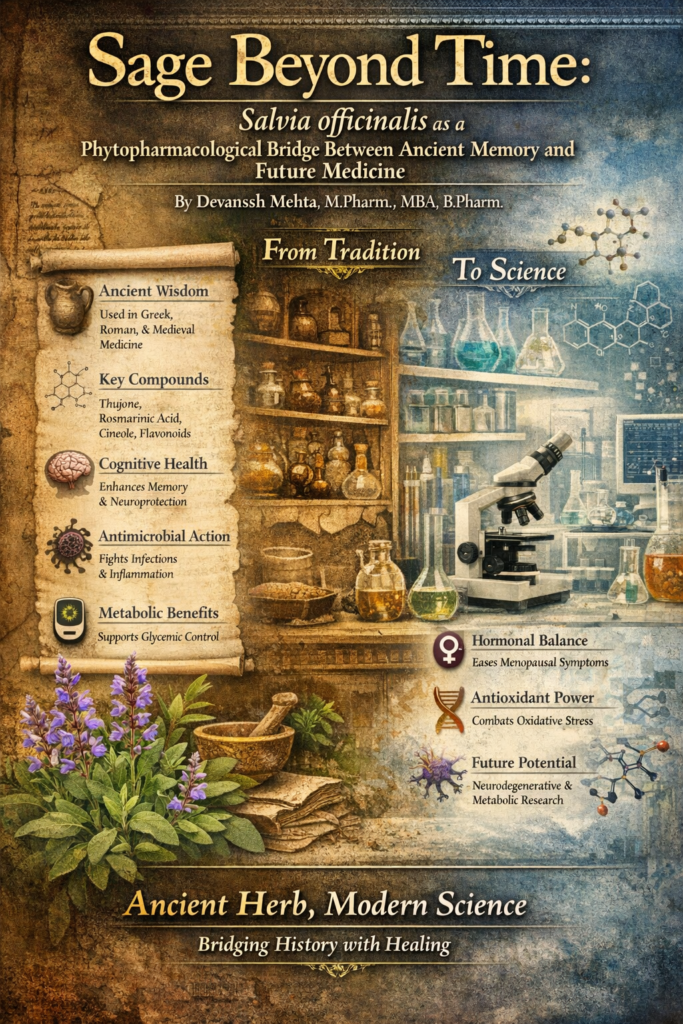
In the silent dialogue between nature and human civilization, certain plants transcend their botanical existence and become intellectual companions of humanity. Salvia officinalis, commonly known as sage, is one such botanical entity. Its name, derived from the Latin “salvare” meaning “to heal,” is not merely linguistic ornamentation but a testimony to centuries of empirical trust. From the stone courtyards of medieval monasteries to the sterile benches of contemporary pharmacognosy laboratories, sage has traveled across eras, geographies, and epistemologies. It has survived the transition from folklore to evidence-based medicine, from culinary herb to neurocognitive enhancer, from ritualistic fumigation to standardized phytopharmaceutical extract. In understanding Salvia officinalis, we are not merely studying a plant; we are exploring a pharmaco-cultural continuum where traditional wisdom intersects with molecular pharmacology.
Botanically, Salvia officinalis belongs to the Lamiaceae family, a family renowned for aromatic and medicinal species. Native to the Mediterranean region, it is now cultivated globally, adapting with remarkable ecological resilience. The plant is characterized by woody stems, grayish-green leaves rich in glandular trichomes, and purple to bluish flowers arranged in whorls. These glandular structures are not passive anatomical features; they are biochemical reservoirs housing volatile oils, flavonoids, phenolic acids, diterpenes, and triterpenoids. The plant’s morphological design is intrinsically linked to its pharmacological potency. The aromatic essence one perceives upon crushing a leaf is, in reality, a complex bouquet of bioactive terpenoids, each molecule participating in a symphony of biological interactions.
Historically, sage was revered in ancient Egyptian, Greek, and Roman civilizations. The Greeks employed it for memory enhancement and digestive disorders, while Roman physicians prescribed it for throat infections and wound healing. In medieval Europe, sage was considered a panacea, encapsulated in the adage: “Why should a man die whilst sage grows in his garden?” Traditional Chinese Medicine integrated sage species for circulatory disorders, while indigenous European traditions used it in rituals for purification and protection. These ethnobotanical narratives, though lacking randomized controlled trials, represent observational pharmacology — centuries of longitudinal human experimentation embedded within cultural practice.
The phytochemical architecture of Salvia officinalis forms the scientific foundation of its therapeutic versatility. The essential oil fraction, typically obtained through steam distillation, contains monoterpenes such as thujone (α and β forms), camphor, cineole, borneol, and pinene. Each of these molecules contributes distinct pharmacodynamic properties. Thujone, a GABA receptor antagonist at high concentrations, explains both the neurostimulatory potential and the caution required in dosing. Cineole offers anti-inflammatory and mucolytic effects, while camphor contributes to antimicrobial and mild analgesic activity. Beyond volatile oils, sage is rich in phenolic compounds including rosmarinic acid, caffeic acid, salvianolic acids, and flavonoids such as luteolin and apigenin. These phenolics act as powerful antioxidants, modulating oxidative stress pathways and influencing inflammatory cascades through inhibition of cyclooxygenase and lipoxygenase enzymes.
One of the most compelling pharmacological domains of Salvia officinalis is neurocognition. Modern neuroscientific research has revisited the ancient claim of memory enhancement with empirical rigor. Extracts of sage demonstrate acetylcholinesterase inhibitory activity, thereby enhancing synaptic acetylcholine availability — a mechanism central to memory and learning. This pharmacodynamic parallel with conventional cholinesterase inhibitors used in Alzheimer’s disease invites profound reflection. Could nature have provided a milder, multitarget modulator long before synthetic molecules were conceptualized? Clinical trials, though limited in scale, suggest improvements in cognitive performance, mood stabilization, and attention in both healthy adults and patients with mild cognitive impairment. Unlike single-target synthetic drugs, sage operates through a polypharmacological mechanism — antioxidant defense, cholinergic modulation, anti-inflammatory action, and neuroprotective signaling — reflecting the inherent intelligence of phytocomplexes.
Beyond neuropharmacology, sage exhibits significant antimicrobial potential. Its essential oils demonstrate inhibitory effects against Gram-positive and Gram-negative bacteria, as well as certain fungal strains. Mechanistically, monoterpenes disrupt microbial cell membranes, alter permeability, and interfere with metabolic enzymes. In an era marked by antimicrobial resistance, phytochemicals like those in Salvia officinalis offer adjunctive strategies, either as direct agents or as synergistic enhancers of antibiotic efficacy. However, the challenge lies in standardization. Plant extracts vary based on geography, soil composition, harvesting season, and extraction methodology. Thus, the transition from traditional remedy to regulated phytopharmaceutical requires rigorous pharmacognostic profiling and chromatographic fingerprinting.
The anti-inflammatory properties of sage further expand its therapeutic horizon. Chronic inflammation underlies numerous non-communicable diseases, including cardiovascular disorders, diabetes, neurodegeneration, and autoimmune conditions. Rosmarinic acid, a dominant phenolic constituent, inhibits pro-inflammatory cytokines such as TNF-α and interleukins. It modulates NF-κB signaling pathways, thereby attenuating transcriptional activation of inflammatory mediators. Such mechanisms position sage not merely as symptomatic relief but as a modulator of pathophysiological processes. The integration of sage extracts into nutraceutical formulations targeting metabolic syndrome is already being explored, reflecting the convergence of herbal medicine and preventive pharmacology.
Metabolically, Salvia officinalis has shown potential in glycemic regulation. Experimental studies indicate that sage extracts may enhance insulin sensitivity, reduce hepatic gluconeogenesis, and improve lipid profiles. Flavonoids and phenolic acids are believed to influence glucose transporters and enzymatic pathways involved in carbohydrate metabolism. While not a substitute for established antidiabetic therapies, sage represents a complementary approach within integrative medicine. Such synergy between phytotherapy and conventional pharmacology demands careful clinical validation to avoid herb–drug interactions, particularly in patients receiving polypharmacy.
The hormonal dimension of sage introduces another layer of complexity. Traditionally used for menopausal symptoms such as hot flashes and excessive sweating, sage appears to exhibit mild phytoestrogenic activity. Although not a potent estrogen receptor agonist, certain flavonoids may modulate endocrine pathways indirectly. Clinical observations report reduction in vasomotor symptoms and improved quality of life among menopausal women consuming standardized sage preparations. However, safety profiling is essential, especially in individuals with estrogen-sensitive malignancies. The pharmacovigilance of herbal products remains a critical yet underdeveloped domain globally.
Antioxidant capacity is perhaps the most widely acknowledged attribute of Salvia officinalis. Oxidative stress, characterized by an imbalance between reactive oxygen species and endogenous antioxidant systems, contributes to cellular aging and chronic disease progression. Sage extracts exhibit strong free radical scavenging activity, attributed to high phenolic content. In vitro assays such as DPPH and ABTS consistently demonstrate significant antioxidant potential. Yet, translating in vitro antioxidant metrics to in vivo clinical outcomes requires cautious interpretation. Bioavailability, metabolism, and systemic distribution determine therapeutic relevance. The journey of a polyphenol from ingestion to target tissue involves complex biotransformation, and understanding these pharmacokinetic parameters remains a frontier in phytopharmaceutical research.
Safety considerations are indispensable in any pharmacological discourse. Thujone, particularly in high concentrations, possesses neurotoxic potential due to GABA antagonism. Excessive consumption may lead to seizures or neuroexcitatory symptoms. Regulatory authorities therefore define permissible limits of thujone in food and medicinal products. Standardized extracts with controlled thujone content mitigate risk while preserving therapeutic efficacy. This delicate balance between benefit and toxicity exemplifies the pharmacological principle that dose determines poison — a doctrine articulated centuries ago yet profoundly relevant in herbal medicine.
The economic and agricultural dimensions of Salvia officinalis deserve equal attention. As global demand for herbal products increases, sustainable cultivation becomes imperative. Overharvesting of wild populations threatens biodiversity. Cultivation under Good Agricultural and Collection Practices (GACP) ensures quality, traceability, and ecological responsibility. India, with its vast agro-climatic diversity and expanding phytopharmaceutical sector, has the potential to integrate sage cultivation within its medicinal plant economy. However, strategic policy frameworks, farmer training, and value-chain integration are prerequisites for achieving pharmaceutical-grade output.
From a pharmaceutical technology perspective, dosage form innovation can redefine sage’s therapeutic accessibility. Traditional preparations include infusions, decoctions, and tinctures. Modern formulations extend to capsules, standardized extracts, essential oil inhalers, mouthwashes, topical gels, and nanoemulsions. Nanoencapsulation strategies may enhance bioavailability of lipophilic constituents, protect volatile compounds from degradation, and enable targeted delivery. The integration of sage into controlled-release systems represents a convergence of ancient herbology with advanced drug delivery science.
In dentistry, sage-containing mouthwashes demonstrate efficacy in managing gingivitis and oral microbial load. Anti-inflammatory and antimicrobial effects synergize to reduce plaque formation and mucosal irritation. This localized therapeutic application minimizes systemic exposure while harnessing phytochemical potency. Similarly, topical preparations leverage sage’s wound-healing and antiseptic properties. The modulation of collagen synthesis and reduction of microbial colonization underpin these benefits.
The psychological dimension of sage is equally fascinating. Aromatherapy applications utilize sage essential oil for stress reduction and mood enhancement. Olfactory pathways directly interface with limbic structures, influencing emotional states. While clinical evidence remains preliminary, anecdotal and small-scale studies suggest anxiolytic potential. Here again, the interplay between volatile molecules and neurobiological circuits underscores the holistic character of phytomedicine.
Yet, amidst enthusiasm, scientific humility is essential. Herbal medicine often suffers from overgeneralization and exaggerated claims. Robust randomized controlled trials, standardized extract characterization, and long-term safety data are necessary to elevate sage from complementary therapy to mainstream therapeutic adjunct. Interdisciplinary collaboration between pharmacologists, botanists, clinicians, and policy makers can transform empirical tradition into validated therapeutic strategy.
Ethically, the resurgence of interest in medicinal plants like Salvia officinalis raises questions of intellectual property and benefit-sharing. Traditional knowledge systems contributed to its recognition long before pharmaceutical commercialization. Equitable frameworks that respect indigenous contributions while promoting innovation are crucial. The global phytopharmaceutical market must not replicate colonial extraction patterns but should embody principles of shared prosperity and biodiversity conservation.
As we project into the future, the relevance of Salvia officinalis may extend into domains such as neurodegenerative prevention, metabolic health optimization, and integrative oncology. Its multitarget pharmacology aligns with the complex pathophysiology of chronic diseases. Unlike reductionist single-molecule paradigms, phytocomplexes offer network-based modulation. Systems biology approaches can elucidate these interactions, mapping how multiple phytochemicals influence interconnected signaling pathways.
In conclusion, Salvia officinalis is not merely an herb; it is a pharmacological narrative woven across centuries. It embodies the dialogue between tradition and science, between kitchen and clinic, between memory and molecule. Its journey from Mediterranean hillsides to global research laboratories symbolizes humanity’s enduring quest to heal through nature. For the pharmacologist, sage represents a reminder that innovation often lies hidden in plain sight. For the clinician, it offers complementary possibilities within evidence-based frameworks. For society, it exemplifies how biodiversity can translate into therapeutic diversity. And for the future of medicine, it stands as a botanical bridge — connecting ancient memory with modern molecular insight, reminding us that sometimes, the wisest remedies are those that have quietly grown beside us all along.