

By Devanssh Mehta
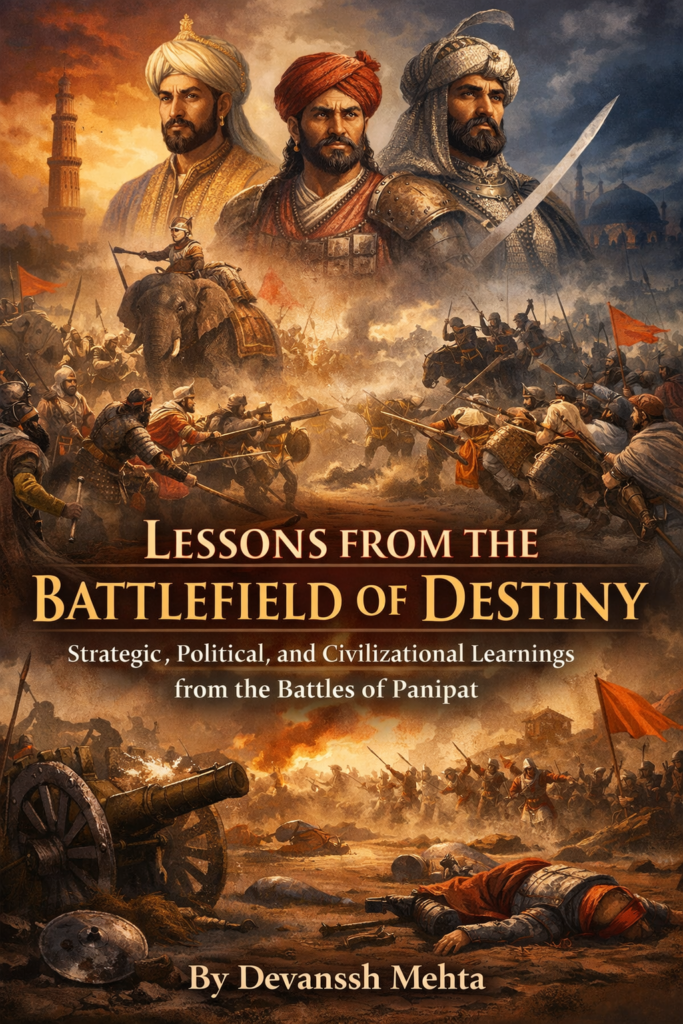
History does not merely record events; it records consequences. There are certain geographical locations that transcend their physical coordinates and become symbols of destiny. Panipat, a modest town in present-day Haryana, is one such place. Situated along the invasion route from the northwest into the fertile plains of northern India, Panipat became the theatre where empires rose, crumbled, and redefined the subcontinent’s political architecture. Three decisive battles—fought in 1526, 1556, and 1761—were not isolated military encounters; they were civilizational turning points. The soil of Panipat absorbed blood, ambition, miscalculation, courage, and betrayal in equal measure. The lessons that emerge from these battles extend far beyond military history. They speak about leadership, strategy, unity, technological adaptation, political foresight, and the fragile psychology of power.
The First Battle of Panipat in 1526 marked the end of the Delhi Sultanate under Ibrahim Lodi and heralded the establishment of Mughal rule in India under Babur. At its surface, it appeared to be a straightforward clash between two armies: Babur’s relatively smaller but disciplined force and Ibrahim Lodi’s numerically superior but structurally flawed army. However, beneath the surface lay a lesson that has echoed through centuries: numerical strength is no substitute for strategic innovation. Babur’s use of field artillery and the Ottoman-inspired tulughma tactics fundamentally altered the dynamics of warfare in the Indian subcontinent. The psychological shock created by cannons against war elephants disrupted traditional battle formations. Panipat in 1526 teaches that technological superiority, when integrated with disciplined command, can neutralize even overwhelming numerical advantage. In modern strategic thought, this principle remains timeless. Innovation is not optional; it is existential.
Equally important was the lesson in leadership contrast. Ibrahim Lodi’s authority was undermined by internal dissent among Afghan nobles, while Babur cultivated loyalty and discipline among his ranks. Leadership in moments of existential confrontation cannot rely solely on inherited authority; it must inspire confidence. The battlefield revealed that fragmentation within command structures invites defeat from external forces. Panipat therefore becomes a metaphor for the dangers of internal disunity. Nations fall not only because of external invasion but because of internal erosion. This lesson would tragically resurface in later centuries.
The Second Battle of Panipat in 1556 was fought between the Mughal forces led by Akbar’s regent Bairam Khan and the forces of Hemu, a formidable general who had temporarily captured Delhi and declared himself king. This encounter, often overshadowed by the first and third battles, carries profound strategic insights. Hemu’s rise demonstrated that political vacuums create opportunities for ambitious and capable individuals. Yet, his defeat also illustrates the unpredictability of war and the decisive role of leadership continuity. When Hemu was struck in the eye by an arrow during the battle, his army’s morale collapsed almost instantly. The incident underscores a stark reality: centralized leadership structures, without distributed command resilience, are vulnerable. A single moment of vulnerability can cascade into systemic collapse.
The Mughal victory in 1556 secured the foundation for Akbar’s expansive and integrative empire. Here, Panipat teaches another crucial lesson—consolidation must follow conquest. Unlike transient conquerors who focused solely on territorial acquisition, Akbar built administrative institutions, promoted cultural accommodation, and pursued policies that stabilized governance. Thus, the battle becomes not just a story of military triumph but a lesson in post-war statecraft. Victory on the battlefield must transition into legitimacy in governance. Without political integration, military success remains ephemeral.
However, it is the Third Battle of Panipat in 1761 that stands as one of the most tragic and instructive episodes in Indian history. The confrontation between the Maratha Confederacy and Ahmad Shah Abdali was not merely a contest for territory; it was a struggle for supremacy over northern India after the decline of Mughal authority. The Marathas, having expanded rapidly across large swathes of India, arrived in Panipat as a formidable power. Yet, their campaign was marred by strategic overextension, supply chain failures, and insufficient alliances with regional powers such as the Rajputs and Jats. Abdali, on the other hand, leveraged mobility, tactical patience, and effective coalition-building.
The tragedy of 1761 lies in the consequences. The Maratha defeat was catastrophic, not only militarily but psychologically. The subcontinent witnessed immense loss of life, and the Maratha momentum toward establishing a pan-Indian polity was abruptly halted. In retrospect, the battle offers sobering lessons about logistics and coalition politics. Military ambition without secure supply lines becomes self-destructive. Geographic expansion without diplomatic consolidation breeds vulnerability. The Marathas fought bravely, but bravery cannot compensate for strategic isolation. Panipat thus reminds us that wars are won as much in negotiation rooms as on battlefields.
Another profound lesson from Panipat is the recurring theme of fragmented unity. In each battle, internal divisions weakened one side more than the strength of the opponent empowered the other. Whether it was Afghan nobility dissenting against Ibrahim Lodi, the instability surrounding Hemu’s command, or the Marathas’ limited regional alliances, fragmentation proved fatal. The pattern is striking. Indian political history repeatedly demonstrates that the absence of cohesive unity creates opportunities for external or rival forces to prevail. Panipat becomes less a location and more a warning—disunity carries generational consequences.
There is also an ethical dimension embedded in these battles. Warfare at Panipat was brutal, and civilian suffering was immense. The Third Battle in particular left fields covered with corpses and families shattered across regions. History must not romanticize such devastation. Instead, Panipat teaches humility. The pursuit of power without foresight extracts a human cost that extends far beyond immediate political gains. In modern contexts, this translates into the necessity of responsible leadership. Decisions taken at the helm of nations reverberate through ordinary lives. Strategic miscalculations are not abstract errors; they are human tragedies.
From a geopolitical perspective, Panipat illustrates the vulnerability of the Indo-Gangetic plain to invasions from the northwest. The region historically lacked a sustained, unified frontier defense mechanism. Each invading force capitalized on internal discord and geographic openness. The lesson for contemporary strategic thought is clear: national security is not solely a matter of military preparedness but also of political coherence and infrastructural depth. Borders are secured not just by armies but by stable governance, economic resilience, and social integration.
Panipat also underscores the importance of adaptability. Babur adapted Central Asian warfare techniques to Indian conditions. Abdali mastered mobility and timing against a relatively heavier Maratha force. In contrast, those who failed to adapt to emerging tactical realities suffered defeat. Adaptability, therefore, becomes a civilizational virtue. Societies that resist change stagnate; those that innovate endure. This principle transcends military history and applies to economic, technological, and intellectual spheres.
Another layer of reflection emerges when one considers morale and psychological warfare. In all three battles, morale shifts played decisive roles. The thunder of cannons in 1526, the fall of Hemu in 1556, and the prolonged starvation of Maratha forces in 1761 shaped outcomes as much as swords and spears. Psychological endurance is often underestimated in historical analysis. Yet, Panipat reveals that the mental resilience of troops and leaders can determine destiny. In modern organizational and national contexts, morale and collective belief remain intangible but powerful forces.
The Third Battle further reveals the dangers of overconfidence born from rapid expansion. The Maratha Confederacy had achieved remarkable success across India, but success may breed complacency. Strategic overreach without adequate consolidation can expose structural weaknesses. This is a recurring phenomenon in global history—empires expand swiftly but collapse under their own logistical burdens. Panipat thus becomes a case study in the limits of ambition. Ambition must be balanced with prudence.
Furthermore, Panipat invites reflection on the role of intelligence and information. Accurate assessment of enemy strength, terrain conditions, and supply capacities determines the feasibility of campaigns. Misjudgments in 1761 regarding alliances and Abdali’s resolve contributed significantly to the Maratha defeat. Information asymmetry remains a decisive factor even in modern warfare and geopolitics. Intelligence failures can be as destructive as battlefield defeats.
The human element of Panipat cannot be ignored. Soldiers on both sides were driven by loyalty, faith, and survival. Leaders were driven by ambition and vision. Yet, the outcomes often diverged from intentions. This tension between intention and consequence is central to historical learning. Leaders may believe they act for glory or security, but unintended consequences may reshape civilizations in unpredictable ways. Panipat reminds us that power must be exercised with foresight, humility, and awareness of complexity.
In examining these battles collectively, one observes a broader pattern: Panipat functioned as a reset mechanism in Indian history. Each battle marked the end of one political order and the beginning of another. In 1526, the Delhi Sultanate fell; in 1556, Mughal consolidation was secured; in 1761, the balance of power shifted, indirectly creating space for the rise of the British East India Company in subsequent decades. Thus, Panipat’s consequences extended beyond immediate victors and vanquished. It shaped the trajectory of the subcontinent for centuries.
There is also a philosophical lesson embedded in Panipat—the impermanence of power. Empires that appear invincible may collapse in a single day. Leaders who command vast armies may fall to a single arrow. Political dominance is transient. Recognizing this impermanence fosters humility and long-term thinking. Nations that understand the fragility of power invest in institutions rather than personalities. They cultivate unity rather than rivalry. They prioritize sustainability over spectacle.
In modern India, Panipat should not merely be remembered as a historical site but studied as a strategic classroom. The lessons extend to national integration, technological innovation, defense preparedness, diplomatic coalition-building, and leadership ethics. Panipat teaches that unity is strength, innovation is survival, logistics are lifelines, morale is decisive, and ambition without prudence invites catastrophe. These principles remain relevant in an era of economic competition, cyber warfare, and geopolitical shifts.
Perhaps the most profound learning from Panipat is the importance of collective memory. A civilization that forgets its strategic lessons risks repeating its mistakes. Historical consciousness is not about dwelling in the past but extracting wisdom for the future. The fields of Panipat are silent today, but their silence speaks volumes. They remind us that destiny is shaped not only by courage but by clarity; not only by strength but by strategy; not only by ambition but by unity.
In conclusion, the Battles of Panipat were not isolated episodes of medieval warfare but defining moments in the making and unmaking of political orders in India. They reveal that technology can overturn tradition, leadership can determine morale, unity can preserve sovereignty, and miscalculation can alter centuries. They caution against fragmentation and celebrate strategic foresight. Above all, they affirm that history is both a teacher and a warning. Panipat stands as a testament to the enduring truth that nations are forged not merely in victory but in the wisdom they derive from their trials.