

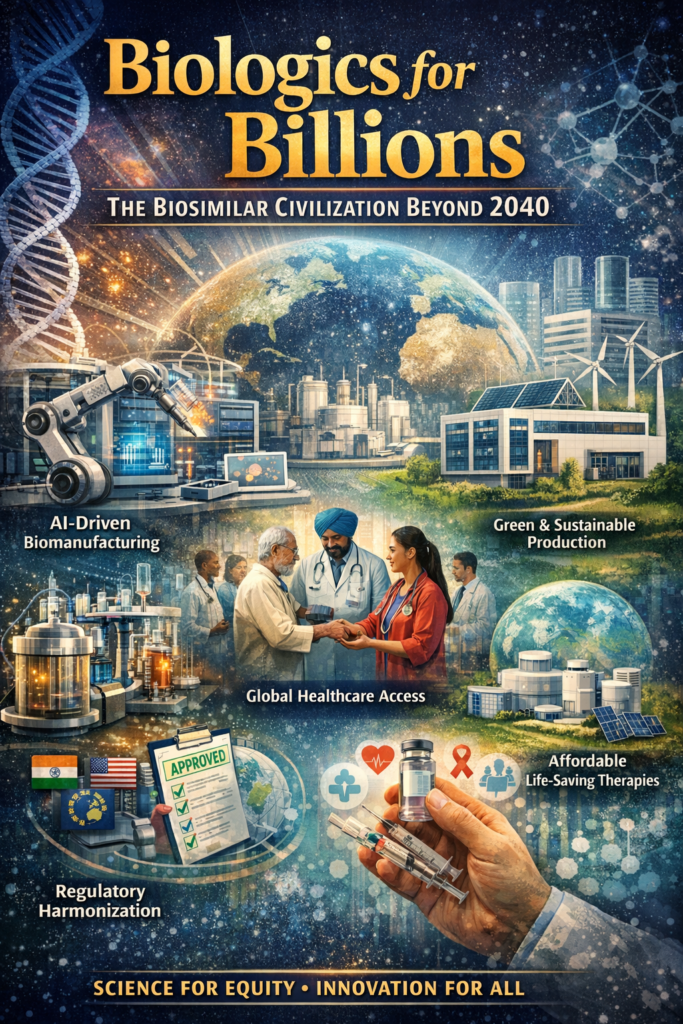
The story of biosimilars beyond 2040 is not merely a scientific extension of recombinant DNA technology; it is the unfolding architecture of therapeutic democratization. If the twentieth century was the era of antibiotics and small molecules, and the early twenty-first century the age of monoclonal antibodies and targeted biologics, then the decades beyond 2040 will be remembered as the epoch in which biologics ceased to be elite interventions and became structured public utilities of global health systems. This transformation will not occur by accident. It will emerge from deliberate regulatory refinement, manufacturing reinvention, digital augmentation, and policy foresight. Biosimilars, often misunderstood as “copies,” will instead stand as technological testaments to human mastery over biological complexity — reproducible, reliable, and increasingly intelligent. Beyond 2040, they will not be peripheral; they will be foundational.
To appreciate the future, one must understand the scientific tension that birthed biosimilars. Unlike generics, biosimilars are born from living systems. Their molecular structures are sculpted not merely by chemistry but by cellular metabolism, glycosylation pathways, and process environments. This intrinsic complexity initially imposed heavy regulatory caution. The early decades of biosimilar development were defined by exhaustive analytical comparability studies, clinical bridging trials, immunogenicity monitoring, and careful pharmacovigilance frameworks. Regulators justifiably demanded rigorous evidence that therapeutic equivalence was not aspirational but demonstrable. The scientific community responded by refining analytical technologies—high-resolution mass spectrometry, advanced chromatography, bioassays with mechanistic specificity, and structural characterization tools that allowed deep molecular mapping. The maturation of these analytical sciences in the 2020s quietly laid the foundation for the acceleration we now project toward 2040.
As we move forward, the most decisive shift will be epistemological rather than procedural. The regulatory mindset will transition from duplicative clinical reassurance to analytics-driven confidence. By the 2030s, high-dimensional structural characterization and functional bioassays, supported by real-world evidence ecosystems, will render many large-scale confirmatory trials redundant. Beyond 2040, biosimilarity will be demonstrated primarily through molecular intelligence — multidimensional fingerprinting validated by predictive computational models. Clinical trials will not disappear, but they will become targeted, hypothesis-driven, and mechanistically informed. This evolution reduces cost, shortens development timelines, and expands global participation. Emerging economies with strong analytical capabilities will enter the biosimilar arena not as low-cost manufacturers but as scientific equals. The democratization of evidence will democratize production.
Manufacturing, however, will be the true battlefield of biosimilars beyond 2040. The bioreactor facilities of the past — stainless steel monoliths requiring massive capital — will give way to modular, digitally orchestrated production ecosystems. Continuous manufacturing will dominate upstream and downstream processes. Single-use bioreactors will integrate seamlessly with process analytical technologies, enabling real-time monitoring of glycosylation patterns, impurity profiles, and potency metrics. Artificial intelligence systems will function as silent supervisors, predicting deviations before they occur, optimizing nutrient feeds, and adjusting parameters dynamically to maintain product consistency. The manufacturing plant will resemble a hybrid of biotechnology and aerospace engineering — automated, sensor-rich, and cybersecure.
Such technological integration carries geopolitical implications. Distributed modular facilities reduce dependency on centralized mega-plants. Nations will strategically deploy regional biosimilar hubs to secure therapeutic sovereignty. India, with its established biopharmaceutical base and regulatory evolution, stands uniquely positioned to lead this distributed manufacturing revolution. By investing in AI-integrated bioprocess engineering, workforce upskilling, and harmonized regulatory science, India can transition from being known as the “pharmacy of the developing world” to becoming the architect of global biologic resilience. Beyond 2040, biosimilars will not merely serve markets; they will stabilize them.
Yet, technology alone does not determine destiny. The market architecture surrounding biosimilars will profoundly shape their societal impact. In earlier decades, biosimilars primarily competed on price, often engaging in aggressive discounting strategies. Beyond 2040, competition will extend beyond cost into value ecosystems. Companies will bundle biosimilars with digital adherence tools, remote monitoring services, patient education platforms, and pharmacovigilance dashboards. Health systems will evaluate not only acquisition price but total therapeutic value—reduced hospitalizations, adherence improvements, and real-world outcome data. In this expanded value framework, biosimilars will compete as integrated healthcare solutions rather than standalone molecules.
Simultaneously, payers will redesign procurement mechanisms. Instead of short-term tender cycles that risk supply instability, long-term performance-based contracts may dominate. Governments will prioritize manufacturers demonstrating supply resilience, environmental sustainability, and pharmacovigilance transparency. The simplistic lowest-bid paradigm will be replaced by multidimensional value scoring. Such procurement sophistication will protect patients from shortages while sustaining industry viability.
A central philosophical challenge emerges when we consider the broader therapeutic landscape beyond 2040. The rise of personalized medicine, gene editing, and cell-based therapies complicates the biosimilar concept. Some biologics of the 2030s and 2040s will be individualized or semi-customized. Can such therapies have biosimilar counterparts? The answer may lie in platform standardization. While patient-specific modifications remain unique, the manufacturing backbone—viral vectors, scaffolds, delivery mechanisms—may become standardized and thus competitively produced. In this sense, the biosimilar philosophy will extend beyond molecules into modular therapeutic components. The biosimilar of 2045 may not replicate a single antibody but may replicate a validated gene-delivery system or cell-expansion module. The scope of biosimilarity will evolve from product replication to platform equivalence.
Ethically, this evolution compels introspection. If biologics represent life-saving interventions, equitable access is not merely an economic aspiration but a moral imperative. Biosimilars beyond 2040 will test whether health systems prioritize distributive justice. Cost savings achieved through biosimilar competition must translate into expanded coverage, preventive care, and investment in neglected diseases. Otherwise, biosimilars risk becoming instruments of corporate competition rather than vehicles of social transformation. Ethical stewardship will require transparent pricing frameworks, robust pharmacovigilance registries, and patient engagement in policy decisions.
Regulatory harmonization will be another decisive axis. By 2040, global regulatory convergence may reduce duplicative dossier submissions and accelerate multi-country approvals. Digital submission portals, AI-assisted review processes, and shared inspection databases will streamline oversight while preserving rigor. However, harmonization demands trust—trust in data integrity, manufacturing audits, and pharmacovigilance reporting. Nations must invest in regulatory science education and collaborative frameworks. Without harmonization, fragmented standards could hinder biosimilar scalability and inflate costs.
From a scientific standpoint, the integration of artificial intelligence into molecular characterization will redefine comparability itself. Predictive modelling of protein folding, glycoform distribution, and receptor-binding kinetics will enable simulation-driven validation. Biosimilar developers will use digital twins of manufacturing processes to anticipate variability and maintain batch fidelity. Real-world evidence platforms, continuously fed by electronic health records and wearable biosensors, will provide longitudinal safety and efficacy data. In this data-rich ecosystem, biosimilarity becomes a dynamic concept—continuously validated rather than statically proven.
Environmental sustainability will also shape the biosimilar civilization. Biomanufacturing, though advanced, consumes significant water, energy, and disposables. By 2040, green bioprocessing innovations—biodegradable single-use systems, energy-efficient perfusion technologies, and circular supply chains—will become competitive differentiators. Governments may incentivize environmentally responsible production, linking procurement eligibility to sustainability metrics. Thus, biosimilars will intersect with climate-conscious industrial policy.
For India, strategic foresight is indispensable. Investments must prioritize three pillars: advanced analytics infrastructure, regulatory-science excellence, and AI-enabled manufacturing ecosystems. Academic institutions should integrate computational biology, biostatistics, and regulatory affairs into core pharmacy and biotechnology curricula. Public–private partnerships must fund pilot modular plants that serve as demonstration models of digital biomanufacturing. Export diplomacy should align with regulatory harmonization initiatives, enabling Indian biosimilars to access regulated markets seamlessly. Beyond 2040, leadership will not be claimed through volume alone but through scientific credibility and systemic reliability.
The social perception of biosimilars will evolve as well. Early skepticism rooted in unfamiliarity will dissipate as decades of pharmacovigilance data affirm safety and efficacy. Physicians trained in evidence-based substitution will view biosimilars as default options rather than alternatives. Patient advocacy groups, informed by transparent data dashboards, will support biosimilar adoption as a pathway to broader therapeutic access. Trust, once fragile, will become institutionalized.
Yet we must guard against complacency. Originator firms will innovate strategically, developing next-generation biologics or incremental modifications to extend exclusivity. Patent thickets and litigation may persist as competitive tools. Policymakers must balance the protection of genuine innovation with prevention of anti-competitive extension tactics. A fair ecosystem rewards discovery while ensuring that essential therapies do not remain indefinitely unaffordable.
By the time the world crosses 2040, biosimilars will likely account for a substantial proportion of biologic prescriptions globally. Oncology, autoimmune disorders, endocrinology, and rare diseases will see expanded access. Health budgets once strained by monopolistic biologic pricing will reallocate funds toward research, prevention, and health infrastructure. The financial elasticity created by biosimilars may enable governments to experiment with universal biologic coverage models. In low- and middle-income countries, biosimilars may transform diseases once deemed fatal into manageable chronic conditions.
The broader narrative, however, is civilizational. Biosimilars represent humanity’s ability to reproduce biological complexity with fidelity and responsibility. They signify that knowledge, once monopolized, can be replicated ethically for collective benefit. Beyond 2040, they will embody a mature pharmaceutical ecosystem—one where innovation and imitation coexist symbiotically, where analytical science underwrites trust, and where manufacturing precision sustains equity.
In conclusion, the era beyond 2040 will not judge biosimilars merely by market share but by societal impact. The measure of success will be the number of patients receiving life-saving biologics without financial catastrophe. It will be the resilience of supply chains during global crises. It will be the degree to which scientific rigor harmonizes with ethical purpose. If guided wisely, biosimilars will become more than pharmaceutical products; they will be structural pillars of global health justice. The choice before policymakers, scientists, and industry leaders today is clear: invest in analytical excellence, harmonize regulatory science, embed digital intelligence into manufacturing, and align economic incentives with public welfare. If these commitments are sustained, the world beyond 2040 will witness a biologic renaissance — not of exclusivity, but of accessibility.