

Reflections, Realities, and a Roadmap for an Inclusive AI Era
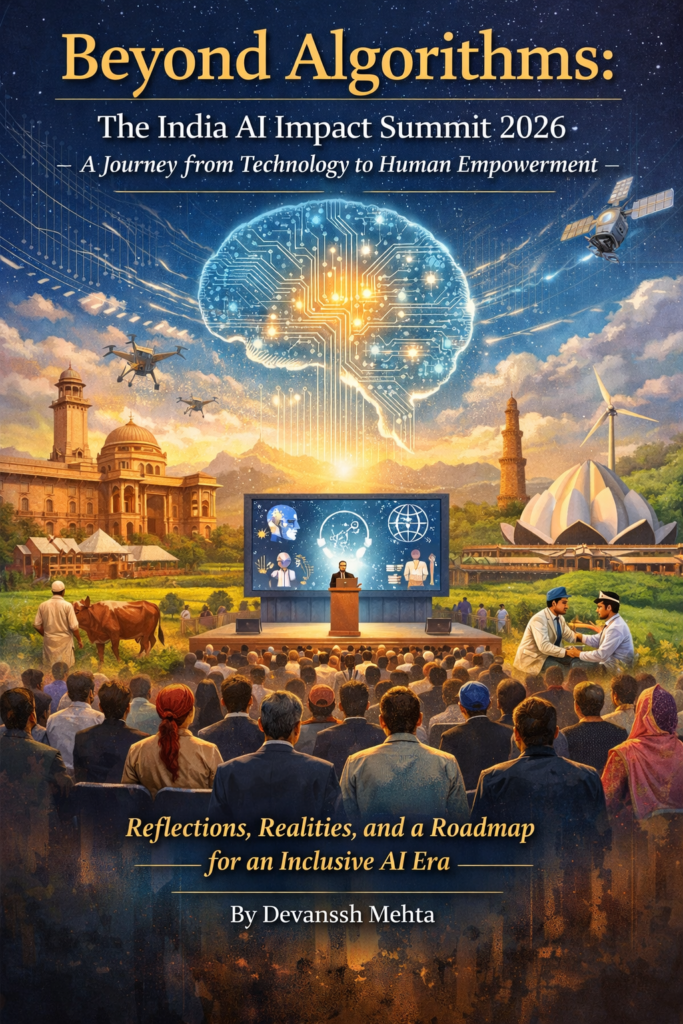
Reflections, Realities, and a Roadmap for an Inclusive AI Era
By Devanssh Mehta
In the early weeks of 2026, as winter receded and New Delhi pulsed with diplomatic energy, a gathering unlike any before took centre stage at Bharat Mandapam: the India AI Impact Summit 2026. Spanning 16–21 February 2026, the event brought together policymakers, technologists, scholars, innovators and civil society voices from some 89 nations and international organisations to chart a shared vision for artificial intelligence rooted not in exclusive technical prowess, but in inclusive impact. This summit marked the first global AI gathering hosted in the Global South, underscoring India’s aspiration to bridge the chasm between technological promise and societal progress.
What emerged from these days of deliberation — in plenaries, panels, workshops, and impromptu dialogues — was not merely a collection of technical roadmaps, but a set of enduring learnings about how AI might be responsibly integrated into the fabric of social, political, and economic life. My reflections on the Summit are anchored in four interwoven themes that provide the scaffolding for the future of AI governance, innovation, and human empowerment: Vision and Values; Practical Realities; Inclusive Designs; and Institutional Pathways.
Vision and Values: India’s AI Compass
From its inaugural hours, the Summit projected a vision that placed human dignity and societal well-being above technological spectacle. Anchored in the age-old Indian ethos of “Sarvajan Hitaya, Sarvajan Sukhaya” — “welfare of all, happiness of all” — the Summit’s discussions emphasised that AI should be a tool for collective uplift rather than proprietary advantage. This philosophical framing was no mere rhetoric; it surfaced in the New Delhi Declaration endorsed by 89 countries and international organisations, emphasising collaborative, trusted, resilient, and efficient AI whose benefits are equitably shared across humanity.
This shift in narrative — from AI safety anxieties to AI for impact and development — reflects a conscious ideological choice. Rather than focusing primarily on existential risks associated with AI, the Summit reframed the agenda to reflect pressing development challenges: education, health, agriculture, sustainability, governance and livelihoods. For practitioners and policymakers alike, this choice signalled that the Summit’s measure of success is not theoretical benchmarks but measurable social outcomes.
Practical Realities: From Commitments to Capabilities
Beyond vision, the Summit surfaced the practical realities — both opportunities and constraints — that define the AI terrain for many nations. One of the most tangible announcements was India’s commitment to strengthen its computing infrastructure by significantly expanding GPU capacity — a critical resource for AI research and model training. Plans to add tens of thousands of GPU units reflect an understanding that innovation without infrastructure remains aspirational.
Similarly, the unveiling of indigenous AI models — including large language models and multimodal systems capable of handling multiple Indian languages — demonstrated that local innovation ecosystems are maturing. Startups like Sarvam AI showcased next-generation language and vision models alongside novel hardware like AI-enabled smart glasses, pointing to a future where AI is both technologically competitive and contextually relevant.
Yet, these advancements also highlighted persistent gaps. Critics and observers noted that, despite high-profile investment pledges and diplomatic enthusiasm, global tech giants and certain developed constituencies remained cautious about binding cooperation on regulation and governance — preferring voluntary frameworks over enforceable standards. This underscores a central truth from the Summit’s practical sessions: global consensus on principles does not automatically yield consensus on enforceable norms.
Inclusive Designs: People, Planet, Progress
One of the most instructive aspects of the Summit was its insistence on aligning AI systems with the lived experiences of diverse populations — especially those historically underrepresented in technological policymaking. Central to the Summit’s architecture were three foundational pillars, or “Sutras”: People, Planet, and Progress. These served as both thematic and ethical lenses through which AI’s impact was to be assessed.
- People emphasised AI’s role in empowering individuals across domains such as health, education, and economic opportunity. This was neither abstract nor symbolic. For instance, AI-based pedagogy models, developed in collaboration with state governments, were celebrated for their ability to personalise learning for students across urban, rural, and vernacular contexts — not by replacing teachers, but by enabling them to tailor instruction.
- Planet foregrounded the use of AI to address environmental and sustainability challenges. Discussions explored how data-driven systems could improve climate resilience, resource efficiency, and disaster response, moving beyond narrow commercial applications to public-good instrumentation.
- Progress integrated governance concerns with economic growth, arguing that AI should enhance public service delivery, strengthen institutional capacity, and ignite indigenous innovation systems.
There was also a conscious effort to democratise AI resources — from multilingual datasets to public compute commons — with an emphasis on open standards and shared infrastructural assets. This represents a significant departure from proprietary monopolies that often concentrate AI capabilities in a few global hubs, ushering instead towards distributed innovation ecosystems.
Institutional Pathways: Governance, Accountability, and Development
A summit of this scale inevitably grapples with the question: how do we translate high-level principles into accountable governance structures? A central takeaway was that AI governance cannot be an afterthought. Instead, accountability, transparency, and citizen empowerment must be embedded across the lifecycle of AI systems.
The New Delhi Declaration articulated voluntary, non-binding frameworks for international cooperation, but the real work lies in building domestic institutions capable of oversight, redress, and enforcement. Independent audit mechanisms, algorithmic impact assessments, transparency portals and legislation protecting civil liberties were cited repeatedly as essential components of effective governance.
Moreover, public procurement emerged as a strategic lever: governments — as large consumers of AI systems — must insist on modular, interoperable, and explainable technologies that resist lock-in and encourage competition. Procurement, therefore, becomes more than a transactional exercise; it becomes a policy instrument capable of steering the AI ecosystem towards equitable outcomes.
The Summit also underscored the importance of workforce transformation. Rather than viewing AI as a force that will simply displace jobs, delegates emphasised dynamic reskilling pathways that integrate technical literacy with domain expertise. Community-level learning hubs, micro-credentials, and modular postgraduate programmes were discussed as mechanisms to ensure that technological progress is accompanied by economic inclusion.
The Human Dimension: Humility and Imagination
Perhaps the most profound learning from the India AI Impact Summit 2026 lies not in any single policy pronouncement or technology showcase, but in the repeated reminder that humility must accompany ambition. Across sessions, speakers reiterated that artificial intelligence — for all its transformative potential — is first and foremost a human endeavour. Its success should be measured not by the sophistication of algorithms, but by the dignity and opportunity it delivers in everyday lives.
In this sense, the Summit’s true legacy will not be a declaration signed by dozens of nations, but the institutional momentum it generates — the frameworks built, the collaborations initiated, and the accountability structures enacted. As we endeavour to operationalise the Summit’s principles, we must remain mindful that AI does not exist in isolation; it operates within the cultural, legal, and ethical fabrics of societies.
Conclusion: From Summit to Sustained Impact
The India AI Impact Summit 2026 will be remembered as a milestone in global AI dialogue — not for the novelty of its technologies, but for the maturity of its questions. It asked: Who benefits from AI? How do we align innovation with justice? What does responsible AI mean on the ground? Answers to these questions will not emerge overnight. They require sustained investment in people, infrastructure, governance, and institutional capacity.
For India — a nation of unparalleled linguistic, cultural, and socioeconomic diversity — the AI journey must be navigated with patience, inclusivity, and rigor. The Summit provided a compass; now the task is to walk the path with discipline, imagination, and public purpose. AI can catalyse profound transformations — in education, health, agriculture, governance and beyond — but only if our policies, institutions and societies are prepared to host, shape, and steward this powerful technology.
The world watched as India hosted this global event; the real test lies in how we translate aspirations into enduring realities. As citizens, scholars, policymakers and practitioners, we must take this moment as both an invitation and an obligation: to build an AI ecosystem that reflects our collective values, respects our plural identities, and advances the common good across every corner of society.