

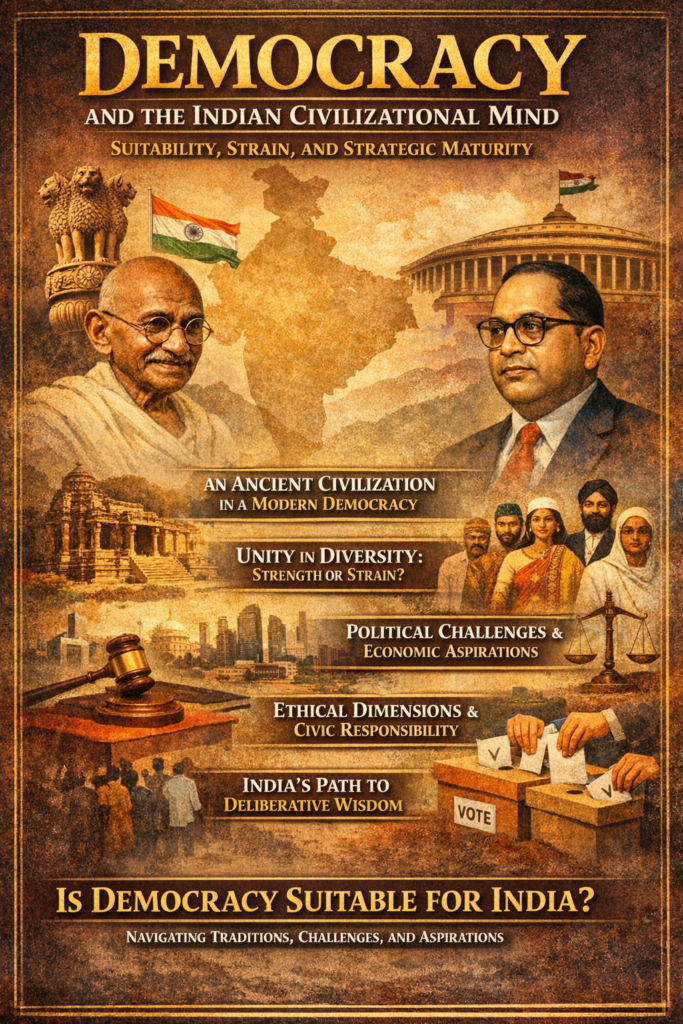
Democracy in India is not merely a constitutional arrangement; it is a civilizational experiment unfolding in real time. To ask whether democracy is suitable for India is not a superficial political inquiry—it is a profound philosophical, historical, and sociological exploration into the compatibility of governance with the Indian civilizational psyche. India is not a newly invented republic artificially constructed in 1947. It is an ancient civilization-state that has repeatedly reimagined itself through millennia of political transformation—from tribal assemblies to imperial monarchies, from confederacies to colonial subjugation, and finally to constitutional democracy. The question, therefore, is not whether democracy was imposed upon India, but whether it harmonizes with India’s deeper cultural DNA, social plurality, and strategic aspirations.
The Indian Republic was formally born on 26 January 1950 with the adoption of the Constitution under the intellectual leadership of B. R. Ambedkar and the moral vision of Mahatma Gandhi. However, democratic impulses were not alien imports from the West. Ancient India had deliberative assemblies such as the sabha and samiti mentioned in Vedic literature, and the gana-sanghas or republican polities in regions like Vaishali demonstrate that collective decision-making predates modern constitutionalism. India’s democracy, therefore, cannot be simplistically described as a transplanted British institution; rather, it represents a modern constitutional expression of older participatory traditions restructured within contemporary legal frameworks.
At independence, India faced formidable structural fragilities—poverty, illiteracy, partition-induced trauma, communal tensions, princely state integration, and fragile administrative infrastructure. Many global observers predicted democratic failure. The global academic consensus of the mid-twentieth century suggested that democracy thrives only in societies with high literacy, economic prosperity, and cultural homogeneity. India possessed none of these prerequisites. Yet the founding generation, led by figures such as Jawaharlal Nehru, chose universal adult franchise from the very first election in 1951–52. This decision was radical, almost audacious. It signified faith in the moral intelligence of ordinary citizens despite socioeconomic deprivation.
To evaluate suitability, one must examine structural compatibility. India is a mosaic of languages, religions, castes, ethnicities, and regional identities. In such a plural society, authoritarian governance may superficially promise order, but it risks suppressing diversity and igniting resistance. Democracy, in contrast, institutionalizes diversity. Through electoral competition, parliamentary debate, and federal distribution of powers, India’s Constitution allows dissent to be ventilated within systemic boundaries rather than erupting into destabilizing rebellion. Federalism permits Tamil Nadu to preserve linguistic pride, Punjab to assert agricultural priorities, and northeastern states to protect tribal identities while remaining within the national framework. Democracy thus becomes not a weakness but a safety valve for pluralism.
However, democracy in India has not been free from strain. The Emergency of 1975–77 under Indira Gandhi exposed vulnerabilities in constitutional safeguards. Civil liberties were suspended, political opponents imprisoned, and press freedoms curtailed. Yet the subsequent electoral defeat of the ruling establishment demonstrated the resilience of democratic consciousness. Indian voters restored constitutional normalcy through ballots rather than bullets. This episode revealed a crucial truth: democracy in India is not merely procedural; it is emotionally internalized by the electorate.
Suitability must also be assessed economically. Critics often argue that democracy slows decision-making and hinders rapid development, citing authoritarian growth models in East Asia. Yet India’s development trajectory demonstrates that democratic accountability and economic reform can coexist. The 1991 economic liberalization initiated under P. V. Narasimha Rao, with strategic economic stewardship, reoriented India toward global markets without dismantling democratic institutions. Unlike centrally controlled economies, India’s reform process was debated in Parliament, contested by opposition parties, and implemented within constitutional oversight. This deliberative process, though slower, ensured social legitimacy and political continuity.
The philosophical foundation of democracy aligns with India’s civilizational pluralism. The Upanishadic tradition encourages dialogue, inquiry, and debate. The Buddhist councils institutionalized collective deliberation. Even medieval Bhakti and Sufi movements democratized spiritual discourse by bypassing rigid hierarchies. Indian civilization has historically accommodated multiplicity rather than enforced uniformity. Democracy, therefore, is not culturally discordant; it is philosophically resonant.
Yet the contemporary Indian democratic experience faces new complexities. The digital age has amplified polarization. Social media ecosystems often privilege sensationalism over deliberation. Electoral campaigns increasingly rely on identity mobilization. Democratic discourse sometimes degenerates into performative antagonism rather than policy-oriented dialogue. These trends raise concerns about whether democracy can mature beyond populism into institutional statesmanship. However, such tensions are not unique to India; they reflect global democratic recalibration in the twenty-first century.
The judiciary has emerged as a stabilizing pillar in India’s democratic architecture. Landmark judgments have expanded civil liberties, strengthened environmental jurisprudence, and clarified constitutional morality. The doctrine of basic structure, evolved through judicial interpretation, prevents arbitrary constitutional amendments that might undermine democratic foundations. This self-correcting mechanism illustrates that India’s democracy is not static; it is self-reflective and adaptive.
Another dimension of suitability lies in India’s demographic character. With one of the world’s largest youth populations, democratic participation becomes a channel for aspiration. Elections mobilize first-time voters who view the ballot not merely as a civic duty but as an instrument of personal empowerment. In authoritarian contexts, youth frustration may translate into unrest; in democratic India, it finds expression through campaigns, debates, and public activism. Democracy thus serves as a psychological release valve for ambition and dissent.
However, democracy also magnifies structural inequalities. Electoral politics sometimes becomes transactional, influenced by caste alignments or short-term populist promises. Developmental policies risk being framed within electoral calculus rather than long-term national interest. To address this, India must evolve from electoral democracy toward institutional democracy—where governance quality, transparency, and evidence-based policymaking transcend immediate vote-seeking incentives.
The suitability of democracy for India must also be viewed through the lens of national security. India is situated in a geopolitically volatile region, bordered by nuclear-armed neighbors and subject to complex strategic pressures. Critics may argue that centralized authority ensures stronger security responses. Yet democratic legitimacy strengthens national cohesion. Military institutions function under civilian oversight, and strategic decisions receive parliamentary scrutiny. This integration prevents politicization of armed forces while maintaining operational autonomy. India’s armed forces remain professional and constitutionally subordinate, a hallmark of democratic maturity rarely achieved in post-colonial states.
One cannot ignore the moral dimension. Democracy affirms individual dignity. In a society historically stratified by caste hierarchies, constitutional democracy created legal equality. Affirmative action policies enabled representation of marginalized communities in legislatures, academia, and public services. While social inequities persist, democracy provides institutional pathways for correction. Without democratic mechanisms, social grievances might calcify into insurgency.
Economically, India’s rise as a global technology and pharmaceutical hub demonstrates the synergy between democratic openness and innovation. Free intellectual discourse, academic mobility, and entrepreneurial freedom flourish in pluralistic environments. Silicon Valley–style ecosystems depend upon freedom of thought, regulatory transparency, and institutional predictability—conditions incompatible with arbitrary authoritarian control. India’s democratic system, despite bureaucratic challenges, fosters a climate where innovation coexists with public accountability.
Critics often highlight inefficiencies—parliamentary disruptions, coalition instability, corruption scandals, and bureaucratic inertia. Yet these are symptoms of evolving democracy rather than proofs of unsuitability. Mature democracies such as the United Kingdom or the United States experienced centuries of turbulence before institutional consolidation. India, by contrast, has navigated seventy-five years of electoral continuity without military coups or systemic collapse. In comparative political science, this achievement is extraordinary.
A nuanced analysis must distinguish between democracy as an ideal and democracy as practiced. The suitability question often conflates procedural flaws with structural incompatibility. India’s democracy requires administrative reform, judicial efficiency, and civic education. However, these are reformative needs, not existential contradictions. The solution to imperfect democracy is deeper democracy—not abandonment of democratic principles.
Civil society plays an indispensable role in this process. Non-governmental organizations, investigative journalism, and academic institutions function as watchdogs. They challenge policy excesses, expose corruption, and articulate alternative visions. While tensions between state authority and civil activism occasionally arise, such friction is intrinsic to democratic dynamism.
Education remains the long-term determinant of democratic maturity. Civic literacy empowers voters to differentiate between rhetoric and policy substance. India’s demographic dividend can become a democratic dividend only if educational reform cultivates critical thinking rather than rote learning. Universities must become arenas of reasoned debate rather than ideological polarization.
Another consideration is economic disparity. Democracy cannot thrive on empty stomachs. Poverty reduction programs, social welfare schemes, and infrastructure development are not merely economic policies; they are democratic stabilizers. When citizens experience tangible improvement in living standards, faith in democratic institutions deepens. Conversely, persistent inequality can erode trust. Thus, economic governance and democratic sustainability are intertwined.
India’s experience also suggests that democracy can coexist with cultural nationalism. National identity does not necessarily contradict democratic pluralism. The challenge lies in ensuring that majority sentiment does not marginalize minority rights. Constitutional safeguards, independent judiciary, and vibrant opposition parties act as balancing forces.
In strategic terms, democracy enhances India’s global credibility. As the world’s largest democracy, India occupies moral high ground in multilateral forums. Its democratic credentials strengthen diplomatic partnerships with liberal democracies while allowing engagement with non-democratic states on pragmatic grounds. Democracy becomes a soft-power asset.
The ultimate test of suitability lies not in theoretical perfection but in empirical endurance. India has conducted regular elections, witnessed peaceful transfers of power, survived insurgencies, weathered economic crises, and navigated social transformations—all within democratic parameters. Few post-colonial nations of comparable diversity have achieved similar continuity.
Yet democracy in India must evolve from majoritarian arithmetic to deliberative wisdom. Parliamentary debates must prioritize policy over personality. Media ecosystems must reclaim responsibility over sensationalism. Citizens must transition from passive voters to informed stakeholders. Democracy is not self-sustaining; it requires ethical vigilance.
In conclusion, democracy is not only suitable for India—it is intrinsically aligned with its civilizational ethos, social plurality, and strategic aspirations. However, suitability does not imply complacency. Democracy in India is a living organism requiring nourishment through education, institutional reform, economic equity, and ethical leadership. The Indian experiment demonstrates that democracy can thrive even in conditions of diversity and developmental challenge. It is not a borrowed garment ill-fitted to Indian reality; it is a constitutional articulation of an ancient pluralistic civilization seeking modern expression.
The question, therefore, must evolve. Instead of asking whether democracy suits India, we must ask whether India will elevate democracy to its highest potential—transforming it from electoral competition into ethical governance, from identity mobilization into inclusive development, and from procedural ritual into civilizational maturity. The future of India’s democracy will not be determined solely by constitutional text but by civic consciousness. If that consciousness remains vigilant, informed, and ethically grounded, democracy will not merely be suitable—it will be India’s defining contribution to global political evolution.