

By Devanssh Mehta, M.Pharm., MBA, B.Pharm.
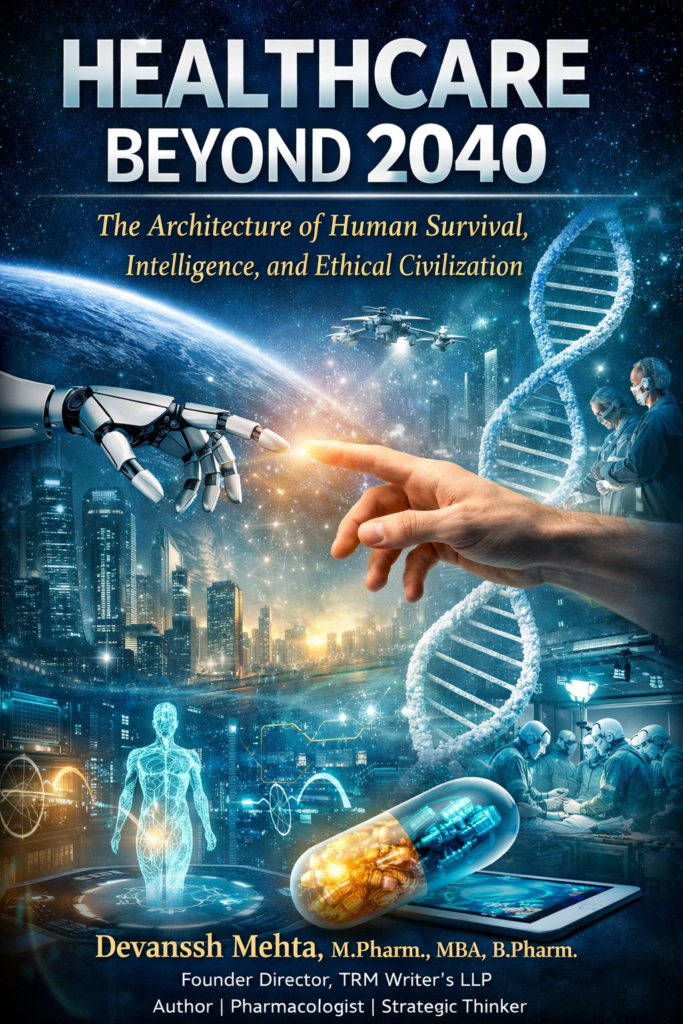
The year 2040 will not merely represent a chronological milestone in the evolution of medicine; it will symbolize a civilizational turning point where healthcare transcends the boundaries of hospitals, pharmaceuticals, and disease management to become the central architecture of human survival, resilience, and ethical progress. When we look at healthcare today, we still perceive it largely through institutional structures—hospitals, clinics, pharmaceutical industries, insurance frameworks, and public health systems. Yet, beneath this visible structure, a silent transformation is underway. Artificial intelligence is redefining diagnosis, genomics is rewriting our understanding of biological destiny, regenerative medicine is questioning the finality of organ failure, and digital ecosystems are transforming patient autonomy. Healthcare beyond 2040 will not simply treat illness; it will anticipate vulnerability, engineer resilience, and redefine the human condition itself.
To understand healthcare beyond 2040, one must first appreciate the trajectory that brought us here. The 20th century was dominated by infectious disease control, antibiotic discovery, vaccination revolutions, and surgical breakthroughs. The early 21st century witnessed the rise of chronic diseases, lifestyle disorders, metabolic syndromes, oncological complexities, and neurodegenerative burdens. Pharmaceutical science shifted from broad-spectrum interventions to precision medicine. Regulatory systems evolved to balance innovation with safety. Digital health emerged as an auxiliary tool. However, these developments, though revolutionary, still operated within a reactive model of care. The fundamental paradigm was treatment after pathology emerged. Beyond 2040, this reactive paradigm will be obsolete.
Healthcare after 2040 will operate primarily on predictive analytics and preventive design. Artificial intelligence systems integrated with continuous biometric monitoring will detect molecular deviations long before symptomatic manifestation. Wearable devices will not merely track heart rate or glucose levels; they will continuously analyze proteomic and metabolomic signatures through minimally invasive sensors. The concept of an annual health check-up will be replaced by perpetual physiological surveillance, ethically governed but technologically seamless. Algorithms trained on multi-ethnic genomic databases will predict susceptibility to cancer, cardiovascular disorders, neurodegeneration, and autoimmune dysfunction with extraordinary precision. In such a world, disease will be a statistical deviation corrected at its inception rather than a catastrophic event requiring emergency response.
Pharmacology, the discipline that has shaped my intellectual and professional life, will undergo one of its most profound metamorphoses. Traditional small-molecule drug discovery, though still relevant, will no longer dominate therapeutic landscapes. Biologics, gene-editing platforms, RNA-based therapies, and cell-engineered treatments will form the core of intervention strategies. CRISPR-derived systems will be refined to eliminate off-target mutations, enabling safe germline corrections for inherited disorders under stringent ethical oversight. Messenger RNA technologies, initially accelerated during pandemic responses, will evolve into customizable therapeutic platforms for oncology, rare diseases, and even neuropsychiatric modulation. Pharmacokinetics will integrate real-time adaptive dosing where nanocarriers release active compounds in response to tissue-specific microenvironmental triggers, guided by AI-regulated biofeedback loops.
Regenerative medicine will redefine the boundaries between life and structural degeneration. Beyond 2040, organ transplantation may no longer depend on donor availability. Bioprinting of vascularized tissues, stem-cell guided organogenesis, and synthetic scaffolds integrated with patient-derived cells will reduce immunological rejection risks dramatically. Myocardial infarction will not culminate in permanent scar formation; cardiomyocyte regeneration will restore contractility. Spinal cord injuries will not imply irreversible paralysis; neuroregenerative scaffolds will re-establish synaptic continuity. Osteoarthritis will not require prosthetic replacement; cartilage regrowth will be biologically stimulated. The body will not be viewed as a failing machine but as a regenerable biological ecosystem.
The hospital of 2040 will not resemble the hospital of today. Physical infrastructures will shrink as virtual infrastructures expand. Remote robotic surgeries, guided by ultra-low latency communication networks, will enable specialists to operate across continents. Intensive care units will incorporate predictive deterioration models that anticipate septic shock or respiratory failure hours before clinical collapse. Emergency departments will integrate drone-delivered medical kits, autonomous ambulances, and rapid genomic triage systems capable of identifying pathogen strains within minutes. Hospitals will become high-complexity intervention hubs rather than primary points of contact. Primary care will largely migrate into homes supported by digital assistants trained in clinical reasoning.
Mental health will occupy a central position in healthcare beyond 2040. The silent epidemic of anxiety, depression, burnout, and cognitive overload that characterized the early decades of the 21st century will compel structural transformation. Neuroimaging integrated with behavioral analytics will detect early cognitive distortions. Personalized neuropharmacology will adapt dosages dynamically based on neural activity feedback. Digital therapeutic platforms will combine cognitive-behavioral interventions with immersive neuro-modulatory environments. However, alongside technological advancement, the ethical challenge will intensify: how far should we modulate the human mind? Where does therapy end and enhancement begin? Healthcare beyond 2040 must guard against commodification of emotional states while addressing suffering with compassion and precision.
Public health architecture will also undergo radical redesign. Climate change, antimicrobial resistance, zoonotic spillovers, and urban density pressures will necessitate anticipatory governance. Epidemiological surveillance will operate in real-time using environmental genomic sequencing, wastewater pathogen detection, and satellite-based ecological monitoring. Pandemic response systems will be pre-programmed with modular vaccine production units capable of rapid deployment. Antimicrobial stewardship will integrate phage therapy and microbiome engineering. Vaccination strategies will become hyper-personalized based on immunogenomic compatibility, minimizing adverse reactions while maximizing efficacy.
India’s role in healthcare beyond 2040 deserves special contemplation. As a nation that has transitioned from generic pharmaceutical dominance to aspirations of knowledge sovereignty, India stands at a strategic crossroads. The demographic dividend, combined with digital penetration and biotech innovation ecosystems, positions India to lead in affordable precision medicine. However, leadership will require regulatory foresight, research funding expansion, academic-industrial integration, and ethical governance frameworks that balance innovation with equity. Rural healthcare must integrate telemedicine grids, AI-assisted diagnostics in primary health centers, and community health worker empowerment. Healthcare beyond 2040 cannot afford urban elitism; it must embody inclusive resilience.
Economically, healthcare will transition from cost center to investment architecture. Preventive models will reduce long-term expenditure by mitigating catastrophic disease burdens. Insurance systems will shift from reimbursement-based models to outcome-based health contracts. Blockchain-enabled medical records will ensure data integrity while preserving patient autonomy. However, data ownership will become one of the most contested ethical terrains. Who owns genomic information? Can corporations monetize predictive health vulnerabilities? The regulatory frameworks of 2040 must ensure that health data remains a sovereign asset of individuals, protected from exploitative commercialization.
Artificial intelligence, though transformative, will introduce epistemological dilemmas. If AI algorithms outperform clinicians in diagnostic accuracy, what becomes of human judgment? The physician of 2040 will not be replaced but redefined. Clinical education will emphasize critical interpretation of algorithmic output, empathetic communication, ethical reasoning, and systems thinking. Medical curricula will integrate computational biology, data analytics, and bioethics alongside anatomy and physiology. The stethoscope will coexist with machine-learning dashboards. Clinical authority will shift from memorization of facts to mastery of integrative reasoning.
Longevity science will further blur the distinction between treatment and enhancement. Senolytics targeting aging cells, telomerase modulation, and metabolic pathway optimization may extend healthy lifespan significantly. The ethical implications are profound. If life expectancy rises dramatically, how will societies restructure employment, retirement, and intergenerational equity? Healthcare beyond 2040 will intersect with demography, economics, and social justice. Equity must remain central; longevity cannot become a privilege reserved for the affluent.
Another dimension that will define healthcare beyond 2040 is planetary health. Human survival cannot be dissociated from ecological balance. Air pollution, water contamination, soil degradation, and biodiversity loss directly influence disease patterns. Healthcare systems will collaborate with environmental agencies to design health-sensitive urban planning. Green hospitals powered by renewable energy will reduce carbon footprints. Pharmaceutical manufacturing will adopt circular economy principles to minimize ecological toxicity. The Hippocratic oath will extend beyond “do no harm” to patients; it will include “do no harm” to planetary systems.
Ethically, healthcare beyond 2040 must confront enhancement technologies. Neural implants improving cognition, gene modifications enhancing physical endurance, and bio-digital interfaces augmenting perception will challenge definitions of normalcy. Regulatory authorities will need to differentiate therapeutic necessity from performance enhancement. Societies will debate whether intelligence amplification should be universally accessible or restricted. The core principle must remain human dignity. Technology must empower without stratifying humanity into biologically enhanced elites and marginalized naturalists.
The pharmaceutical industry will evolve from product-centric models to platform ecosystems. Drug discovery pipelines will integrate quantum computing simulations for molecular docking, reducing trial-and-error inefficiencies. Clinical trials will become decentralized, with digital biomarkers replacing invasive endpoints. Adaptive trial designs will shorten approval timelines while maintaining safety. Pharmacovigilance systems will operate through real-time data analytics, identifying adverse reactions globally within hours. Regulatory harmonization across nations will facilitate faster therapeutic access while preventing exploitation.
Healthcare beyond 2040 will also witness the rise of community-driven wellness cultures. Nutrition will be precision-tailored based on microbiome profiling. Physical activity regimens will adapt dynamically through wearable analytics. Education systems will integrate preventive health literacy from early childhood. The concept of health will shift from absence of disease to optimized biological potential. However, this shift must avoid moralizing illness. Not all disease is preventable, and healthcare must retain compassion for unavoidable vulnerability.
Spiritual and psychological dimensions will re-emerge in technologically advanced healthcare ecosystems. As medicine becomes data-driven, patients will still seek meaning in suffering and healing. Integrative models combining evidence-based complementary therapies with conventional medicine may gain acceptance under scientific scrutiny. Mind-body interactions will be quantified rather than dismissed. The reductionist model of the body as isolated organs will give way to systems biology recognizing interconnected physiological networks.
In conflict zones and disaster-prone regions, healthcare beyond 2040 will incorporate rapid-deployment medical drones, portable genomic labs, and AI-driven triage systems capable of functioning autonomously. Military medicine will integrate regenerative technologies to reduce mortality in battlefield trauma. Civilian emergency systems will benefit from these innovations, blurring the line between defense and public health.
Education and training of healthcare professionals will undergo radical redesign. Lifelong learning will be mandatory as technologies evolve rapidly. Simulation-based training with immersive virtual reality will enhance surgical precision. Ethical training modules will address AI biases, data privacy, and equitable resource allocation. Healthcare leadership will require interdisciplinary fluency spanning biology, engineering, policy, and philosophy.
Perhaps the most profound transformation beyond 2040 will be psychological. Humanity will begin to perceive health not as episodic repair but as continuous stewardship. The relationship between individual responsibility and systemic support will be recalibrated. Governments will invest in social determinants of health—education, sanitation, nutrition, housing—recognizing that biological intervention alone cannot ensure well-being. Healthcare will integrate with governance, economics, and cultural values.
As we envision healthcare beyond 2040, one must acknowledge that technological possibility does not guarantee ethical wisdom. The same gene-editing tools that eliminate disease could be misused for discriminatory design. The same AI algorithms that predict illness could be weaponized for surveillance capitalism. Therefore, ethical foresight must parallel technological advancement. Multilateral cooperation, global bioethics councils, and transparent regulatory systems will be indispensable.
In conclusion, healthcare beyond 2040 will not simply represent an advanced version of contemporary medicine; it will redefine the ontology of health itself. Disease will be anticipated rather than reacted to. Organs will be regenerated rather than replaced. Data will guide but not dominate clinical judgment. Longevity will expand but must remain equitable. Environmental stewardship will integrate with medical responsibility. Ethical governance will determine whether technological power uplifts humanity or fragments it. The future of healthcare is not merely about curing illness; it is about designing a civilization where biological resilience, technological intelligence, and moral responsibility coexist harmoniously. Beyond 2040, healthcare will stand not at the periphery of human progress but at its very center, shaping how we live, how long we live, and how justly we live together as a species.